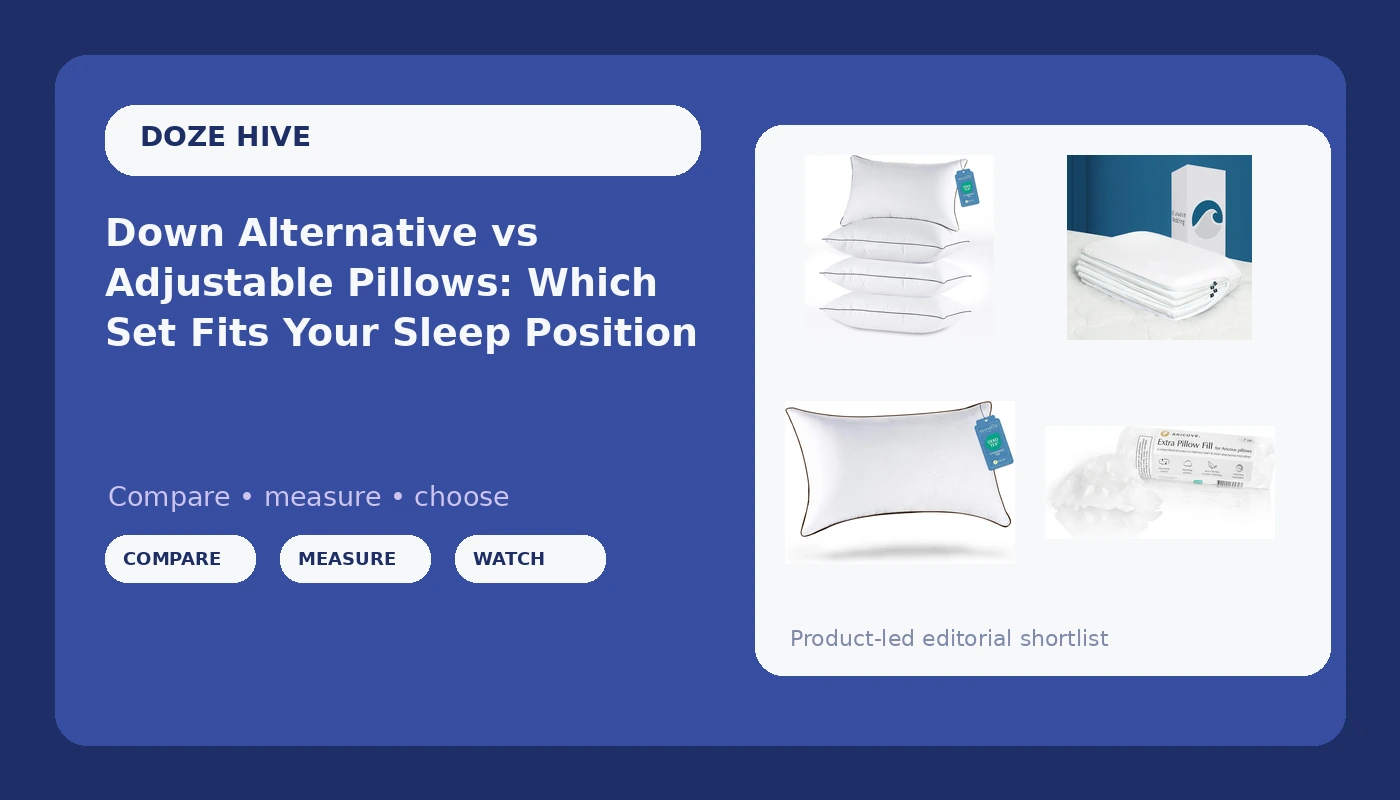
I have bought, slept on, and returned more pillows than any retired teacher should admit to. My husband Tom is a lifelong side sleeper, I sleep on my back with a CPAP mask and an adjustable bed, and the guest room gets whichever stomach sleeper shows up next. That is three different pillows on any given night, which is exactly why this down alternative vs adjustable pillows comparison exists. The four products below are the ones I would actually put in a cart this fall: two down alternative sets from JOLLYVOGUE, an adjustable layer pillow from Bluewave Bedding, and a bag of Aricove fill that rescues a pillow you already own.
Short answer: the JOLLYVOGUE queen set of four is the best value for a couple or a guest room, the Bluewave Versalayer is the one to buy if your loft needs change from night to night, and the Aricove fill is the cheapest way to save a good pillow that has gone flat. The rest of this article is the long answer, position by position.
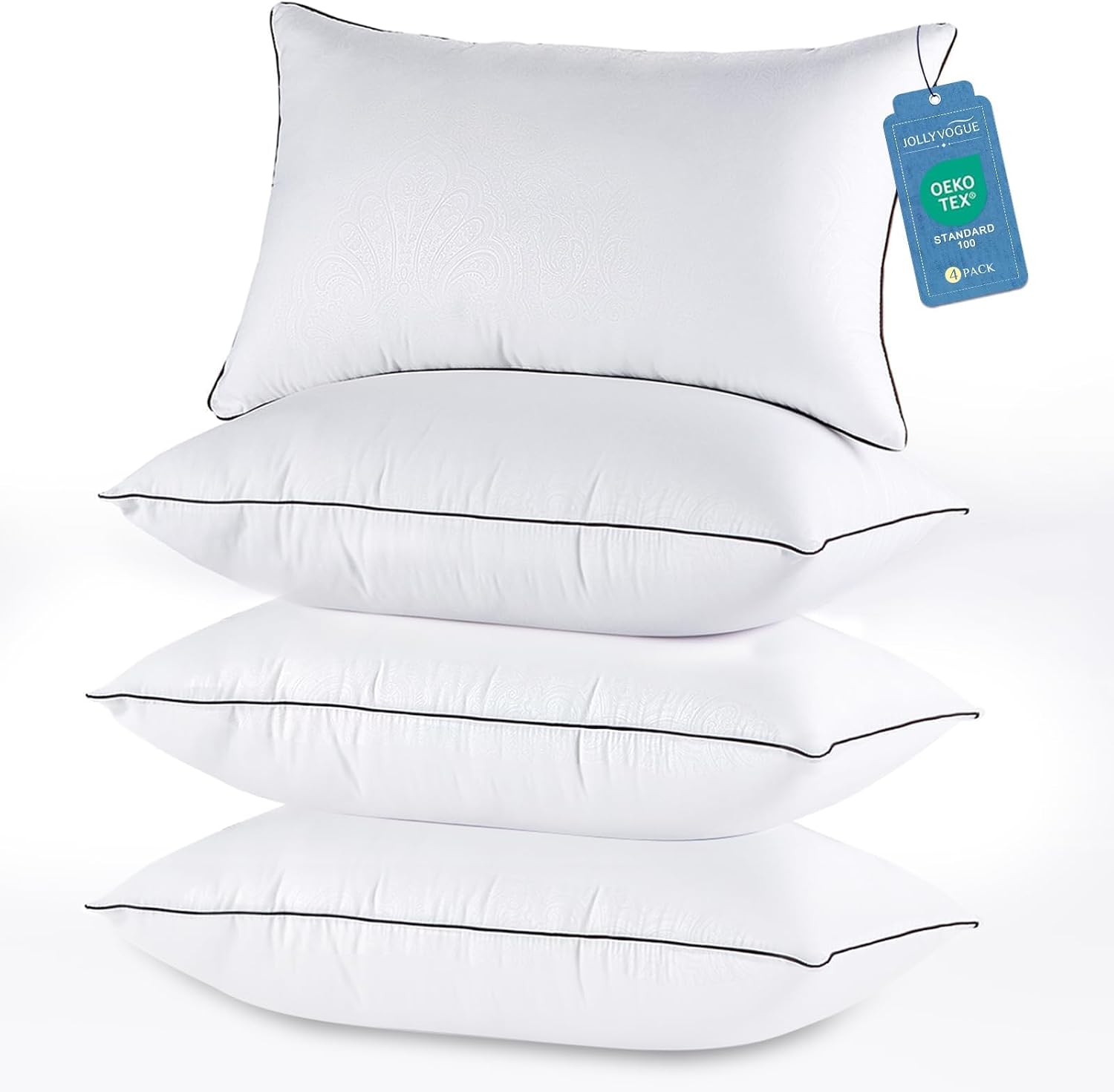
JOLLYVOGUE Pillows Queen Size Set of 4
Best per-pillow value here, Oeko-Tex certified down alternative that moves with your head instead of fighting it, and four pillows cover a whole bed or a guest room
Down alternative loses loft in a year or two, and "firm" here means firm for a down pillow, not firm like a foam block
Bluewave Bedding Versalayer Adjustable Layer Pillow
Six stackable memory foam layers give twenty heights from 0.75 to 6 inches, so one pillow covers stomach, back, and side sleepers in the same house
Memory foam sleeps warm for a hot sleeper, loose layers can shift overnight, and it costs more than a down alternative
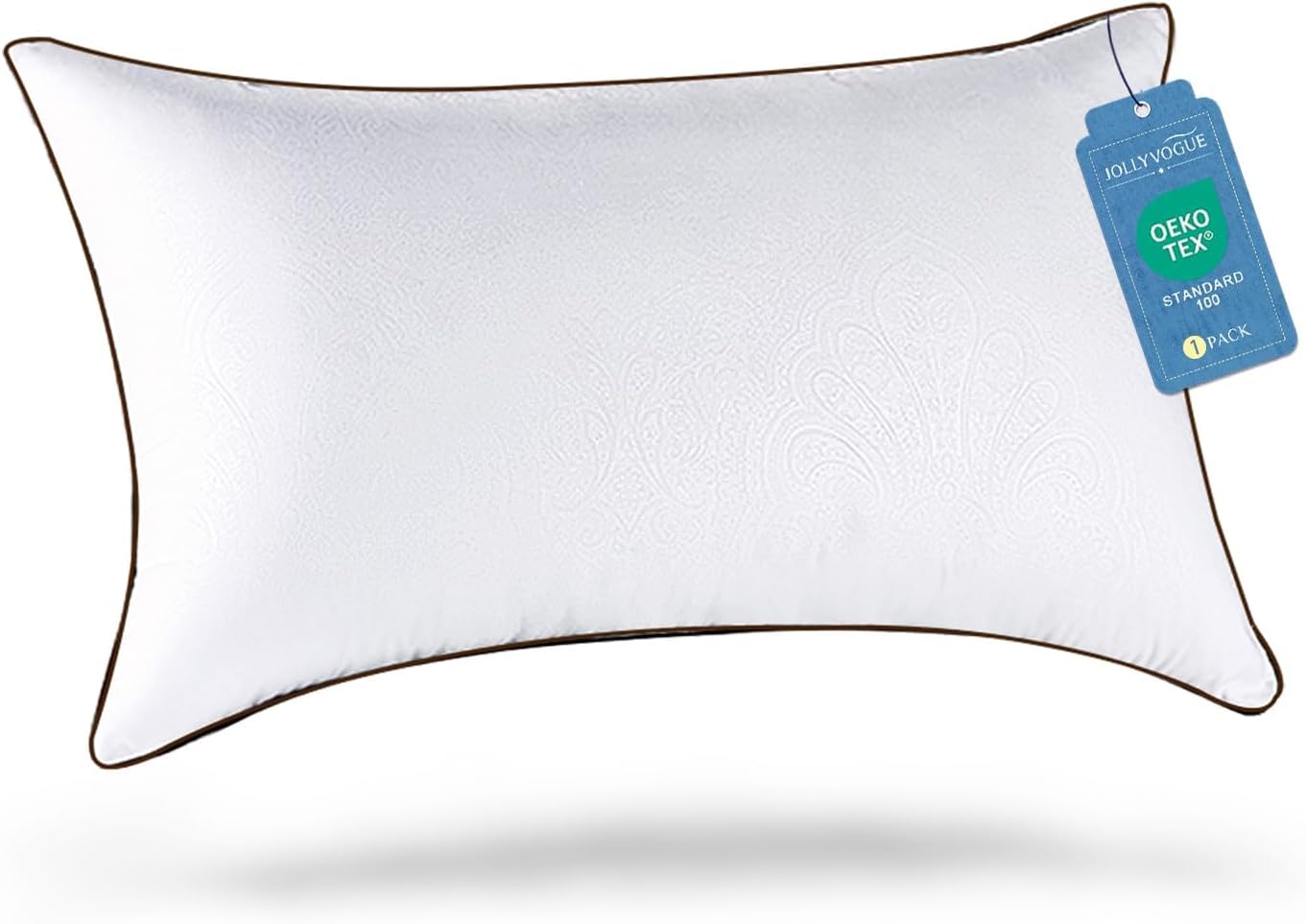
JOLLYVOGUE Standard Pillows Set for Sleeping
The lowest entry point in the group, same Oeko-Tex certified down alternative fill and cooling, firm feel as the queen set
Standard size only, the listing does not spell out the count in the title, and it flattens on the same schedule as any down alternative
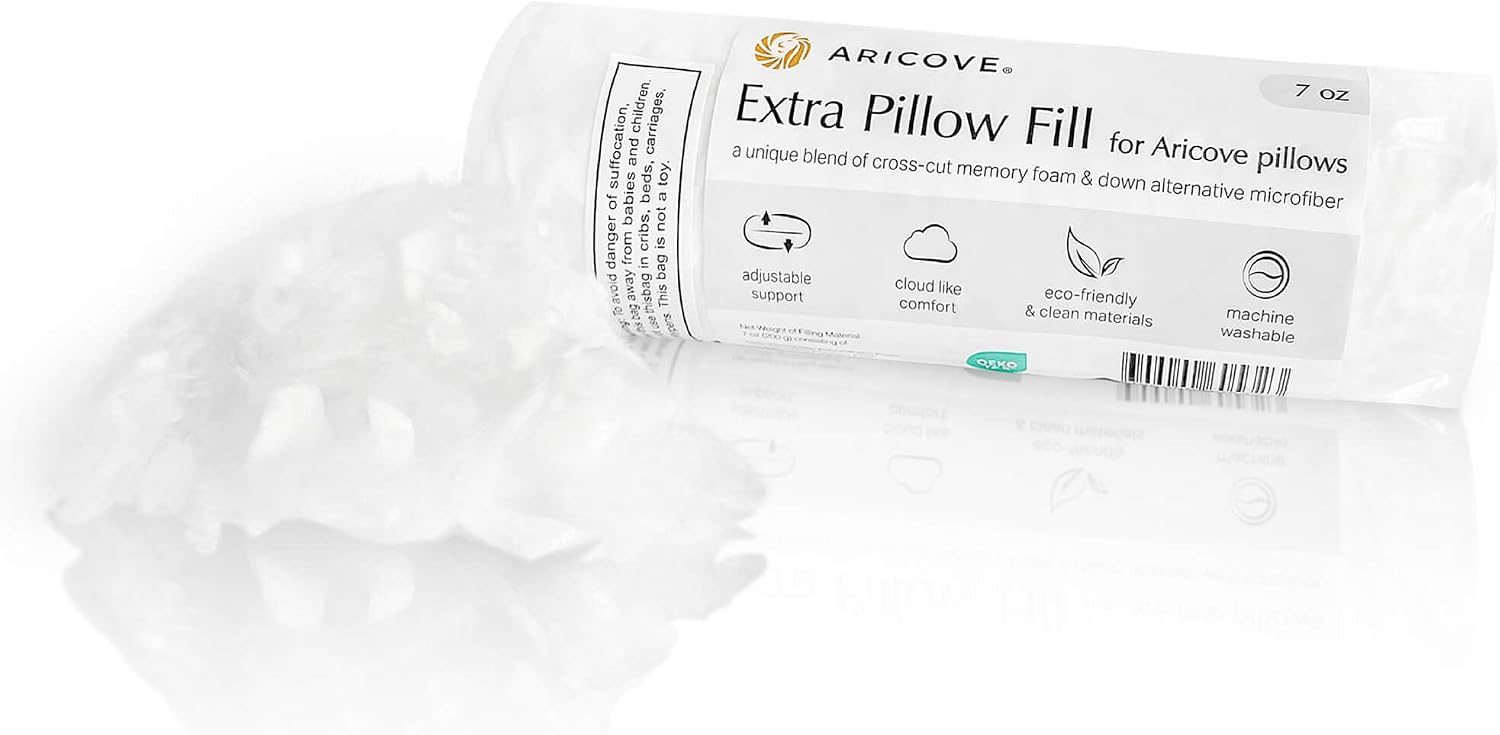
Aricove Extra Pillow Fill
Cheapest fix in bedding, crosscut memory foam blended with down alternative microfiber, 7oz bag that brings a flat sleep pillow or body pillow back to life
It is a top-up and not a pillow, seven ounces will not rebuild a truly empty casing, and it changes how a pure down pillow feels and breathes
Prices and availability were captured from Amazon Creators API and may change.
How I judge a pillow
Every pillow that makes a list in this house gets the same treatment, because firmness claims mean nothing until you have slept on them. I have ordered "firm" pillows that arrived very soft and thin, and I have returned every one of them. So I check four things, every time.
Fill first. What is actually inside, how much of it, and can I feel the casing sag when I press the middle with my palm. A pillow that goes concave under light pressure is a pillow that will have a flat spot under my neck by 3 a.m.
Loft through the night. I start on my back, roll to my side for a stretch, and lie on my stomach for the last few minutes before I get up. The side position is the honest test, because my shoulder pushes my head down and my neck takes the bill. If a pillow cannot hold its loft in the side position, nothing else it does matters.
Cooling at 2 a.m. I sleep warm, so I am the test. A cooling cover is not the same thing as a fill that breathes, and I have been fooled by a brushed microfiber cover more than once.
And lifespan. A pillow is a five-year purchase, not a thirty dollar impulse. Divide the cost by the years it lasts and the expensive pillow becomes the cheap one. That math is why I still keep a buckwheat pillow on my own bed and a down alternative in the guest room.
The JOLLYVOGUE sets: down alternative in two footprints
Both JOLLYVOGUE pillows are the same idea at two sizes: a cooling, firm-feeling pillow with Oeko-Tex certified down alternative filling, sold as a hotel collection, and described as suitable for side, back, and stomach sleepers. If you want one recommendation and no more reading, this is the family of pillows I would start with.
The queen set of four is the one I would buy first. Four pillows covers a queen or king bed, or a guest room with spares, and it is the best per-pillow math in this group. Down alternative has one real advantage over foam that people forget: it moves. It envelopes your head and part of your shoulder instead of making you negotiate with a brick, and it plumps back up in the morning with thirty seconds of work.
The standard set is the same construction in a smaller footprint, and it is the lower entry point if you only need one or two pillows. One thing to verify before you order: the queen listing says set of four, and the standard listing does not spell out the count in its title, so read the bullet points and confirm how many arrive in the box. I have been burned by that exact assumption before, and it is the kind of thing that turns a good deal into a return.
Where both of these lose points is the same place every down alternative loses. The fill goes flat faster than memory foam, usually somewhere around month twelve to eighteen depending on your weight and how warm you sleep. I check loft at month three and again at month twelve, and I have watched good down alternative pillows turn into pancakes. "Firm" on a down alternative pillow is also relative. It means supportive compared to a soft hotel pillow, not supportive compared to buckwheat hulls or a solid foam block. And "hotel collection" is a marketing phrase until the stitching, fill, and casing survive a real wash, so run them through a gentle cycle before you decide you love them.
Visit on Amazon → for the queen set of four, or Visit on Amazon → for the standard set.
Bluewave Bedding Versalayer: the adjustable one
This is the most interesting pillow in the group, and the one I would hand a stomach sleeper without hesitating. The Versalayer is not one pillow. It is six thin memory foam layers you stack inside a standard size case, which gives you twenty heights between three quarters of an inch and six inches. You adjust height and firmness by adding or removing layers.
That range is the whole point. Stomach sleepers need something almost flat, and most pillows on the market start too tall for them, which is how people end up folding a pillow in half and wondering why their neck hurts. At the low end this pillow is genuinely thin. At the high end it is a real side sleeper pillow with enough loft to fill the gap between head and shoulder.
The trade-offs are honest ones. Memory foam sleeps warmer than down alternative, so a warm sleeper should expect to notice the difference by 2 a.m. no matter what the cover claims. Six loose layers can shift if you are a restless sleeper, and reassembling a pillow at 3 a.m. because you pulled a layer out in your sleep is nobody's idea of a good night. And it costs more than a down alternative pillow, which brings the amortize question right back: if adjustable height is what keeps you from buying and returning three pillows this year, it is the cheaper purchase.
Visit on Amazon → for the Versalayer.
Aricove fill: the fix for a pillow you already like
The Aricove extra pillow fill is not a pillow. It is a seven ounce bag of crosscut memory foam blended with down alternative microfiber, meant to stuff a sleep pillow or a body pillow that has gone flat.
This is the item I recommend most often, because most people do not need a new pillow. They need the pillow they already own to have fill in it again. If your casing has a zipper, or if you are willing to open a seam on a pillow you were about to throw out, this is the cheapest repair in bedding. Cheaper than a new pillow, cheaper than a new set, and it keeps a casing you already like out of the landfill.
Two caveats. Seven ounces is a top-up, not a rebuild, so measure before you order. If your pillow is truly empty, one bag may not be enough, and even two bags still cost less than a replacement. And match the fill to the pillow. Adding crosscut foam to a pure down pillow changes how it feels and how it sleeps, so if what you love about your pillow is the way it breathes, think twice before you stuff it.
Visit on Amazon → for the Aricove fill.
Side, back, and stomach: three pillows, not one
This is the part most buying guides skip, and it is the only part that matters.
Side sleepers need loft. Your shoulder creates a gap between your head and the mattress, and something has to fill it. A thin pillow leaves your head hanging and your neck bent, which is how you wake up with a headache you blame on the mattress. In this group the queen down alternative set and the top of the Versalayer's height range are the two answers. Tom noticed the weight and loft of a good pillow the first night, and side sleepers always do.
Back sleepers need the middle. Enough loft to support the curve of the neck, not so much that your chin tips toward your chest. I sleep on my back with a CPAP mask, and I will tell you what I tell everyone in the apnea forums: a pillow that pushes your chin down is a pillow that makes the mask worse. A medium down alternative loft is the easiest starting point, which is why the JOLLYVOGUE sets sit on my own bed.
Stomach sleepers need thin. This is where the Versalayer wins outright, and where almost everything else fails. A stomach sleeper on a six inch pillow is sleeping with their neck rotated for eight hours, and no cooling cover fixes that.
The cooling claim, checked at 2 a.m.
Cooling is the most lied-about word in bedding. A cooling cover does not mean the fill is not cooking you by 2 a.m., and I have the receipts to prove it. Cover fabric can wick and feel cool for the first twenty minutes. The fill decides the rest of the night.
Down alternative breathes better than solid memory foam, generally. That is the honest reason the JOLLYVOGUE pillows sleep cooler for me than a foam pillow of the same loft, and it has nothing to do with the word cooling printed on the package. If you are a warm sleeper who wants foam, the Versalayer's thin layers put less foam under your head than a solid block, which helps, but it is still foam and it still holds heat.
The amortize math
Here is how I think about this group. The queen set of four is the lowest cost per pillow by a wide margin, and if each pillow lasts two years in a rotation, that is a very small number per pillow per year. The Versalayer costs more up front, but it replaces the stomach pillow and the side pillow and the back pillow, so it replaces three purchases. And the Aricove fill is the cheapest item here by far, and it extends the life of something you already paid for.
Divide any of them by five years and the argument changes. That is the whole reason I stopped buying thirty dollar pillows that go flat by week two.
Who should buy which
Buy the JOLLYVOGUE queen set of four if you are furnishing a bed or a guest room, or if you sleep on your back or side and want a soft, breathable pillow that will not fight your shoulder. It is the best value here and the easiest recommendation.
Buy the Bluewave Versalayer if your household has a stomach sleeper, or if your loft needs change with the seasons or with a new mattress. It is the only pillow in this group that adjusts instead of arguing.
Buy the JOLLYVOGUE standard set if you need one or two pillows in a smaller size and you want the same fill at the lowest entry point.
Buy the Aricove fill if your current pillow has gone flat but the casing is still good. It is a repair, not an upgrade, and it is the cheapest way to get another year out of what you own.
What I am doing next
The guest room gets its upgrade this month, and the down alternative set is the front runner because the crunch of buckwheat is not for everyone who stays over. I am still rotating the Versalayer layers to find the setting that works for a stomach sleeper at the lowest height, and I will keep logging neck pain and 2 a.m. temperature the way I always do. If a pillow cannot survive a wash, a side sleeping husband, and a warm sleeper who wakes up at two in the morning, it does not belong on this list.