Most people buy a pillow the way they buy a candle. They like the look, the price is reasonable, and they hope for the best. Three weeks later they are waking up with a sore neck and a flat spot where their head used to be. Choosing a pillow by sleep position is a much shorter route to a decent night, because side, back, and stomach sleepers need very different amounts of loft, and no single fill serves all three.
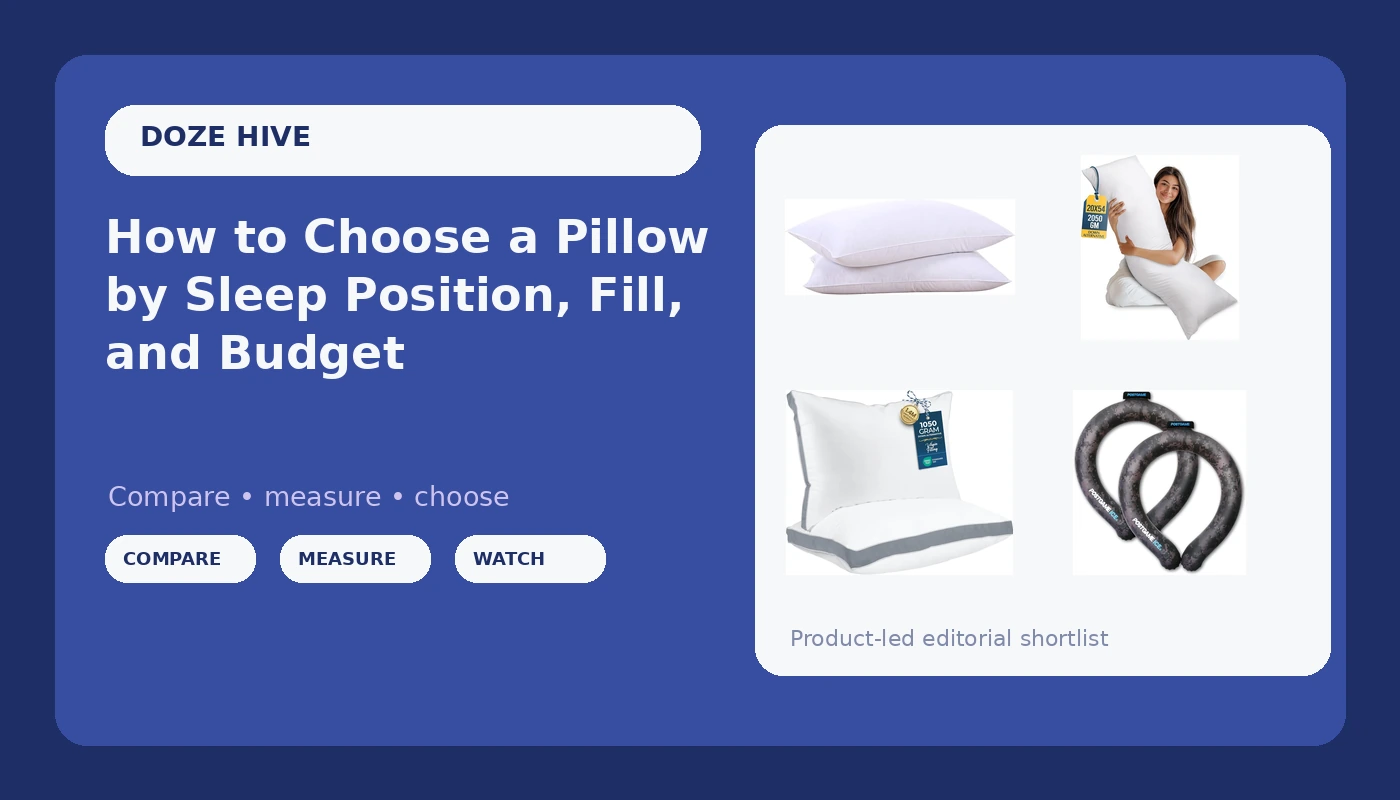
This guide covers four options that handle the most common problems: a traditional goose feather and down set, a gusset pillow sold as a queen two-pack, a full body pillow built for side sleepers, and a reusable cooling neck wrap for nights when heat is the issue. I'll explain what each one is for, where it falls short, and how to tell which belongs on your bed.
Related: Down vs Down Alternative: What Pillow Fill Actually Feels Like →
Quick answer
Match the pillow to your dominant sleep position first, then to your budget and your temperature. Side sleepers generally need the most loft, and often a body pillow to keep the hips and knees stacked. Back sleepers tend to do well with medium loft and some structure, which is where gusset construction helps. Stomach sleepers need the least loft of the three. If you sleep hot, treat cooling as its own purchase rather than trusting a cover. Down and feather gives a soft, moldable, traditional feel, a gusset holds a defined edge instead of collapsing into a flat seam, a long body pillow supports the whole side-sleeping posture, and a gel neck wrap delivers targeted cooling that a fabric cover cannot.
Four useful options
| Model | Best fit | What stands out |
|---|---|---|
| puredown Goose Feathers and Down White Pillows, Standard, Set of 2 | Sleepers who want a soft, traditional down feel | Goose feather and down fill with a 100% cotton cover, sold as a set of two standard pillows |
| Utopia Bedding Gusset Bed Pillow, Queen, Set of 2, Grey | Back and combination sleepers who want a defined edge | Gusset construction creates a side wall so the pillow keeps height across the surface, in a queen two-pack |
| Utopia Bedding Full Body Pillow for Side Sleeper, White | Side sleepers who need support along the whole body | A long body pillow sized for wrapping and for filling the gap at the hip and knee |
| rituo Postgame Cooling Neck Wrap, Reusable Gel Ice Pack, L/XL, Pack of 2 | Hot sleepers and anyone cooling a warm neck | Reusable gel ice packs shaped for the neck and shoulders, sold in a two-pack |
The down set: puredown Goose Feathers and Down White Pillows
Down and feather is the fill that rewards you for handling it. It compresses under your head, then springs back when you roll over, which is why side and back sleepers who like a soft landing tend to come back to it. The trade-offs are real. Down migrates, so a pillow can end up with a dense corner and a thin spot under your neck by morning unless you shake it out. It also needs a genuine wash routine rather than a quick spin, and anyone with a feather allergy should look at a down alternative instead. Read the care label before you buy, because a pillow you cannot wash is a pillow with a shorter life.
The structured set: Utopia Bedding Gusset Bed Pillow
Gusset construction is one of the few pillow features you can evaluate before you sleep on it, because it is visible in the stitching. A flat-seam pillow tapers toward the edges, which is fine if you sleep dead center and never move. A gusseted pillow keeps its height out toward the edges, so a back sleeper who shifts around at night does not slide into a thin spot. The limitation is that structure cuts both ways: a gusseted pillow feels firmer and less moldable than down, and if you like to bunch a pillow up under your neck, it will resist you. Two pillows in a queen size also makes this an easy set to split between a bed and a guest room.
The side-sleeper body pillow: Utopia Bedding Full Body Pillow
Side sleeping is the position where a standard pillow most often comes up short, because the gap between your ear and the mattress is roughly the width of your shoulder. A head pillow alone cannot close that gap and stabilize the rest of you. A body pillow addresses the second half of the problem: with something to wrap an arm around and something between the knees, the upper body stops rolling forward and the lower back stops twisting. The catch is space. A long pillow takes up a real share of a queen or full bed, it needs a larger pillowcase, and couples who share a bed sometimes negotiate its presence. It also does nothing for a back sleeper.
The cooling add-on: rituo Postgame Cooling Neck Wrap
Cooling is the most oversold word in bedding. A cover can feel cool to the touch when you first lie down and still leave you hot at two in the morning, because the fill underneath is what traps heat. A gel wrap sidesteps that entirely: it is cold because it was in the freezer, and it goes back in when it warms up. The two-pack matters here, because one pack can be chilling while the other is in use. What it is not is a pillow. It will not change your loft or your neck alignment, and it is not a substitute for a washable cover or a proper head pillow. Treat it as an add-on for warm sleepers, for hot flashes, or for a sore neck after a long day.
Prices and availability may change. Product images, names, and retailer links must be matched by verified ASIN. Do not state a current price, rating, stock status, or measured result without current evidence.
Why sleep position decides the pillow
Loft, which is the height of a pillow once your head is on it, is the number that actually matters. Everything else is preference.
Side sleepers need enough loft to fill the space between the mattress and the side of the head, roughly the distance from the base of the neck to the outer edge of the shoulder. Too low and the neck bends downward through the night. Too high and it bends upward. Both positions leave you stiff by morning, and both are common when a pillow has gone flat but nobody has noticed.
Back sleepers need less height but more consistency, because the head sits directly over the spine and a pillow that collapses in the middle pushes the chin toward the chest. A structured pillow with a gusset holds its shape better here than a soft flat-seam pillow.
Stomach sleepers need the least loft of the three, sometimes almost none, because the head is turned to the side and a tall pillow rotates the neck. If you sleep on your stomach, a thin pillow or a folded towel is often the honest answer.
If you use a CPAP, mask and hose positioning add a wrinkle, since a pillow that pushes the mask sideways causes leaks. I won't give medical advice on that, but head and neck support is worth discussing with your clinician.
What fill and construction actually change
Down and feather is soft, light, and moldable. It compresses and recovers, which suits sleepers who move around. It needs fluffing, it can migrate, and it demands proper washing and drying.
Down alternative is polyester, generally machine washable and less expensive. It starts crisp and can flatten over time, and quality varies enormously between brands.
Memory foam contours and holds its shape, but it is dense, it can sleep warm, and it often arrives vacuum sealed with an odor that needs airing.
Buckwheat hulls are heavy, adjustable, and supportive, and they sound like a bag of cereal for the first few nights. The hulls compress over years of use.
Gusset construction is a sewing detail rather than a fill, and it is the easiest feature to verify with your own eyes. A gusseted pillow keeps its height across the surface instead of tapering toward the edges.
Cooling is usually a claim about a cover, not about the fill. If overheating is your problem, a chilled gel pack is a more direct answer than a fabric description.
- Track your sleep position for a week, noting the position you wake up in rather than the one you fall asleep in.
- Lie on your side and estimate the gap between your neck and the mattress, then compare it to the loft of your current pillow.
- Choose loft first, fill second, and cover material last.
- Check the care label and the return window before you commit, since firmness claims are unreliable until you have slept on the pillow.
- Divide the price by the number of years you expect to keep it, and compare that annual figure across your options.
Practical guidance: plumping, washing, and cost per year
- Give a vacuum-sealed pillow a day or two to expand fully before judging its loft.
- Follow the care label exactly. Down usually needs a gentle cycle and thorough drying, and a damp fill will clump.
- Use a pillow protector under the case, especially with down, and wash the protector more often than the pillow.
- Fluff and rotate your pillow regularly, and check whether it still springs back when folded in half.
- Amortize the purchase. A pillow kept for five years costs a fifth of its price per year, which changes how the budget conversation goes.
Which option should you choose?
Choose the puredown Goose Feathers and Down White Pillows when you want a soft, moldable, traditional down feel and you are willing to fluff and wash it properly. Choose the Utopia Bedding Gusset Bed Pillow when you want a structured pillow that holds its height across the surface, or when you need a queen two-pack to cover a bed and a guest room. Choose the Utopia Bedding Full Body Pillow when you sleep on your side and want support along the whole body rather than just under the head. Choose the rituo Postgame Cooling Neck Wrap when heat is the thing keeping you awake and you want cooling that does not depend on a marketing claim.
These four solve different problems, so the honest answer for a couple sharing a bed is often two of them. Nothing here is a medical device, and none of these descriptions substitute for checking the current listing, the care instructions, and the dimensions against your own mattress and sleeping habits.
The bottom line
Start with your sleep position, because it determines how much loft you need, and loft is the part you will notice on the first night. Side sleepers need the most height and often benefit from a body pillow, back sleepers do well with medium loft and a structured gusset, and stomach sleepers need very little. After that, pick a fill you are willing to maintain, decide whether cooling is a real problem or just a phrase on a label, and divide the price by the years you expect to keep it. That math is what turns a $30 impulse buy into a $100 pillow you actually keep.