Most people shopping for a pillow for neck pain start with the wrong question. They type "firm pillow" into a search bar, order whatever has the most reviews, sleep on it for three nights, and then blame their neck when it still hurts.
I know, because I did that for 15 years. I'm Diane. I'm 58, I live in Austin, Texas, and I have returned more Amazon pillows than I can count. I slept on the same Tempurpedic foam pillow for more than 20 years and loved it. When it finally flattened out, I ordered replacement after replacement and sent every single one back. Too hard, too soft, too expensive, and going flat by month three.
Here is what I finally figured out. Neck pain is almost never solved by a better pillow in the abstract. It is solved by matching the fill, the loft, and the shape to the position you actually sleep in, and then giving the pillow two weeks before you decide anything. Tom, my husband, is a lifelong side sleeper. I sleep on my back. The guest bed gets stomach sleepers. Every pillow in this house gets tested three ways, or it does not get recommended.
So this is the order of operations: how to choose a pillow for neck pain without buying and returning six of them first.
Why you should trust me
I am not a sleep doctor and I will not pretend to be one. I am a retired middle school teacher with a CPAP machine, blackout blinds, an air filter that doubles as white noise, and an adjustable bed. I take sleep seriously because I have to.
What I have is receipts. Fifteen years of them. I have bought, slept on, washed, and returned more pillows than I can count, and I keep a night-by-night log the way I used to keep attendance. Neck pain gets scored 1 to 10 every morning. I write down how many times I woke up, whether the fill had migrated to one corner, and whether I was hot at 2 a.m. Tom logs the side-sleeping position. The guest room logs stomach sleepers.
No pillow makes it into a recommendation here without at least two weeks of real nights in all three positions. That is the whole method.
How I picked and how I tested
Right now I have eight pillows in a 30-night rotation, and the two below are the ones that survived it. I am not testing them for a weekend. I am testing them the way you actually use a pillow, which is eight hours a night, every night, in the position you actually sleep in.
I check four things, in this order.
First, what is actually inside. Fill type, and whether I can feel the fill through the casing or whether it is a thin shell over nothing.
Second, whether it holds its loft through the night. A pillow that is lofty at 10 p.m. and flat at 3 a.m. is not a pillow, it is a countdown.
Third, whether it sleeps cool. This is the most lied-about claim in bedding. A cooling cover does not mean the fill is not cooking you by 2 a.m. I sleep warm, so I am the test.
Fourth, how long before it goes flat, because that is what decides whether the price was fair. Amortize it over five years and the math changes completely. The pillow that holds its loft for years is the cheap one.
One more thing before we get to the pillows. I will tell you what supported my neck and my CPAP mask. I will not diagnose yours. If your neck pain runs down your arm, or you wake up numb, that is a conversation for a doctor, not a bedding blog.
The two pillows I would start with
If you are starting from zero and your neck hurts, most people fit one of two situations. Either you want a normal-shaped pillow that works for a back or stomach sleeper, or you need contour support because you sleep on your side. These two cover those cases.
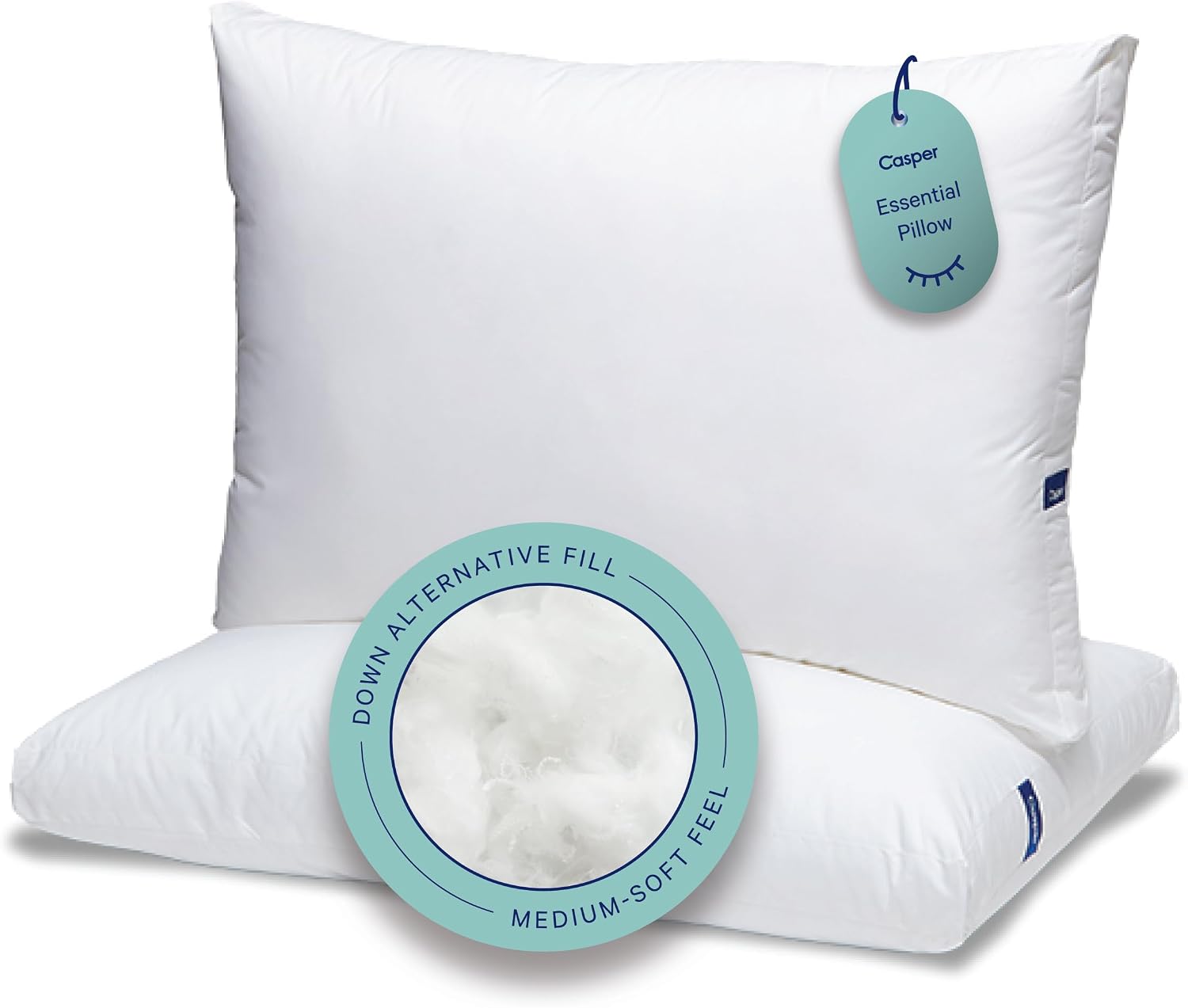
The everyday pick for back and stomach sleepers: Casper Sleep Essential Pillow 2-Pack, Standard Down-Alternative Bed Pillow
 Visit on Amazon →
A down alternative is the pillow I hand to almost everyone who is not sure what they want, and this two-pack is the version I would start with. It is soft, it envelopes your head instead of fighting it, and it does not have the chemical odor that hits you when you open a vacuum-sealed foam pillow. The casing is the part I check first on any down alternative, and this one holds up.
Two packs matter more than people think. One goes on the bed, one goes in the wash rotation, and if you keep a guest room, you have just solved the guest room.
Flaws but not dealbreakers: a soft down alternative is not a contour pillow. If you sleep on your side and need the gap between your head and your shoulder filled, this will not do it alone. It also will not hold loft forever. Down alternative compresses, and I check mine at month three and month twelve the way I check everything else.
Anyone who sleeps on their back or their stomach, and anyone who just wants a normal pillow that does not smell like a factory, will be happy here.
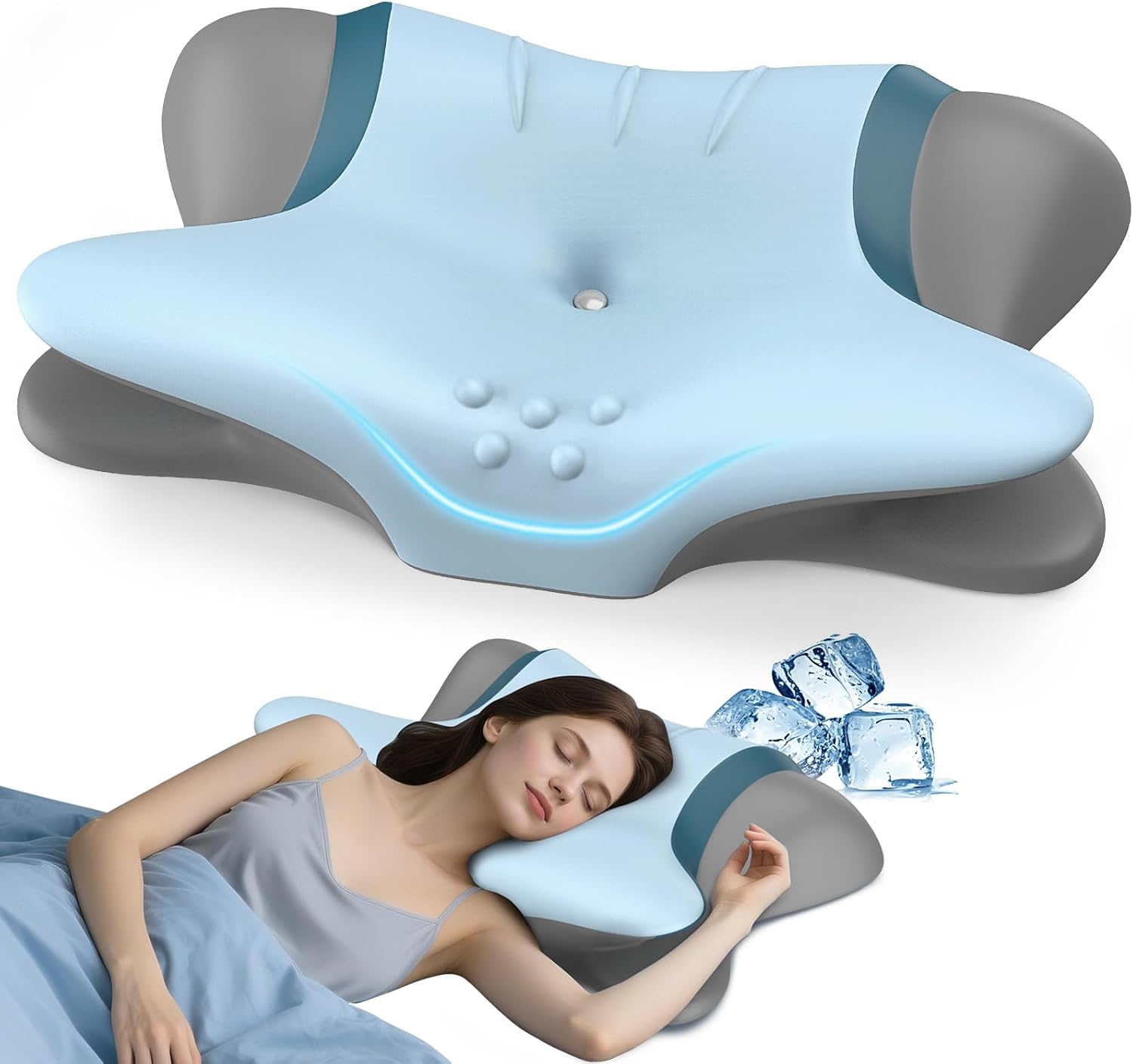
The neck support pick for side sleepers: Cervical Pillow for Neck Pain Relief, Ergonomic Neck Pillow for Sleeping, Orthopedic Side Sleeper Pillow for Neck Support, Cooling Memory Foam Pillows Contour Pillow for Back Stomach Sleepers (Blue)
 Visit on Amazon →
This is the shape to look at if you wake up with a stiff neck and you sleep on your side. The contour gives your neck a place to rest instead of letting your head drop toward the mattress all night, and the cutouts mean the pillow is not pushing your shoulder backward.
It is memory foam, which means two things. First, it arrives vacuum sealed and flat as a pancake, and you need to give it two full days to plump before you judge it. I have zero patience and slept on the flat version the first night anyway, so I know exactly how that goes, and I also know it is not a fair test.
Second, memory foam off-gasses. Open the bag, let it breathe in a spare room, and if a chemical odor is still there after a week, send it back. That is a dealbreaker no matter how good the reviews are.
On the cooling question: the cover is cool to the touch and the fill is still foam. If you sleep hot, that is the honest answer, and it is exactly why I test at 2 a.m. and not at bedtime.
Flaws but not dealbreakers: contour pillows are a shape commitment. Stomach sleepers usually hate them, because the contour lifts the head too far back. If you flip between positions all night, a plain pillow is a safer bet.
Anyone who sleeps on their side, wakes up with neck pain, and wants the pillow to do the work instead of adjusting it all night should start here.
How to choose a pillow for neck pain, step by step
Now the actual workflow. This works whether you buy one of the pillows above or something else entirely.
Step one: figure out your position before you shop. Not the position you fall asleep in. The position you wake up in. Tom falls asleep on his back and wakes up on his side, and he is a side sleeper. Shop for the morning position.
Step two: measure the gap. Lie on your side and look at the space between your neck and the mattress. That gap is your loft target. A side sleeper with broad shoulders needs a taller pillow than a back sleeper. This is why one pillow that claims to work for everyone usually works for no one.
Step three: pick your fill by how you sleep, not by what is on sale. Back and stomach sleepers do well with down alternative, which is soft and forgiving. Side sleepers with neck pain usually do better with a contour foam or a buckwheat pillow that holds its shape. Combination sleepers should stay with something soft and normally shaped, because you are asking one pillow to do three jobs and the simple shape is the only one that can.
Step four: check the fill, not the firmness label. "Firm" has burned me before. Firm Amazon recommendations arrived very soft and thin more than once. Press on it. Can you feel actual fill, or is it a casing with air in it? Fill that migrates to one corner by morning leaves a flat spot under your neck, and that flat spot is what you wake up with.
Step five: let it plump. Almost everything arrives vacuum sealed now. Two full days, out of the bag, somewhere it can breathe. Then fluff it.
Step six: run a two-week test in your own position. Two weeks is the minimum. Score your neck pain in the morning on a 1 to 10 scale, and write it down. Memory is useless here. I have convinced myself a pillow was fine and then looked at the log and seen six straight mornings of 6s.
Step seven: run the 2 a.m. cooling check. Do not judge cooling at bedtime, when the room is cool and you are not. Judge it at 2 a.m. If you are flipping the pillow to find the cold side, the cover is marketing and the fill is the problem.
Step eight: amortize before you return it. Divide the price by the years you expect it to last. A pillow you keep for five years costs a fifth of its price per year. That math is how the better pillow beats three cheap ones, and it is also how you talk yourself into the right pillow instead of the cheapest one on the page.
If you have a CPAP, one more note. Your mask seal depends on your head staying put. A pillow that lets your head roll forward can push the mask out of position and wake you up with a leak. Contour support helped me more than any mask adjustment ever did.
What I compared and why it is not here
I keep a Beckham set in the guest room because the crunch of a buckwheat pillow is not for everyone, and I still measure every pillow against the pure down pillow Tom and I splurged on years ago. Both are good. Neither is what I would hand a person who is waking up with neck pain, because soft is not the same as supported.
I have also cut open cheaper adjustable pillows that were half empty by month six. That is the whole reason I check fill before I check anything else.
I will say the quiet part: I bought my first down alternative because of an influencer video. I hate to admit that part. What I learned is that the video got me to the category, and two weeks of nights told me whether the pillow was any good.
What this all costs
Amortize it. That is the entire budget argument.
A pillow is a five-year purchase, not an impulse buy. Divide the price by the years it actually lasts and the math flips. The cheap pillow you replace every eight months is the expensive one. The pillow that holds its loft for five years is the cheap one, even if it costs three times as much on the day you click buy.
The other cost is the returns. Every pillow you send back is a box, a trip, and two weeks of bad sleep you do not get back. That is why the steps above matter more than the price tag.
For the two pillows in this guide, check the current Amazon price at the links above and run the division yourself. Then give whichever one you pick two weeks in your own position before you decide anything.
The short version
Figure out the position you wake up in. Match the loft to the gap between your neck and the mattress. Pick the fill for that position, not for the sale. Let it plump for two days. Log two weeks. Check the cooling at 2 a.m., not at bedtime. Then amortize the price over five years and stop feeling guilty about the pillow.
Your neck does not care what the box said. It cares whether it was supported at 3 a.m. That is the only test that has ever mattered in my house.