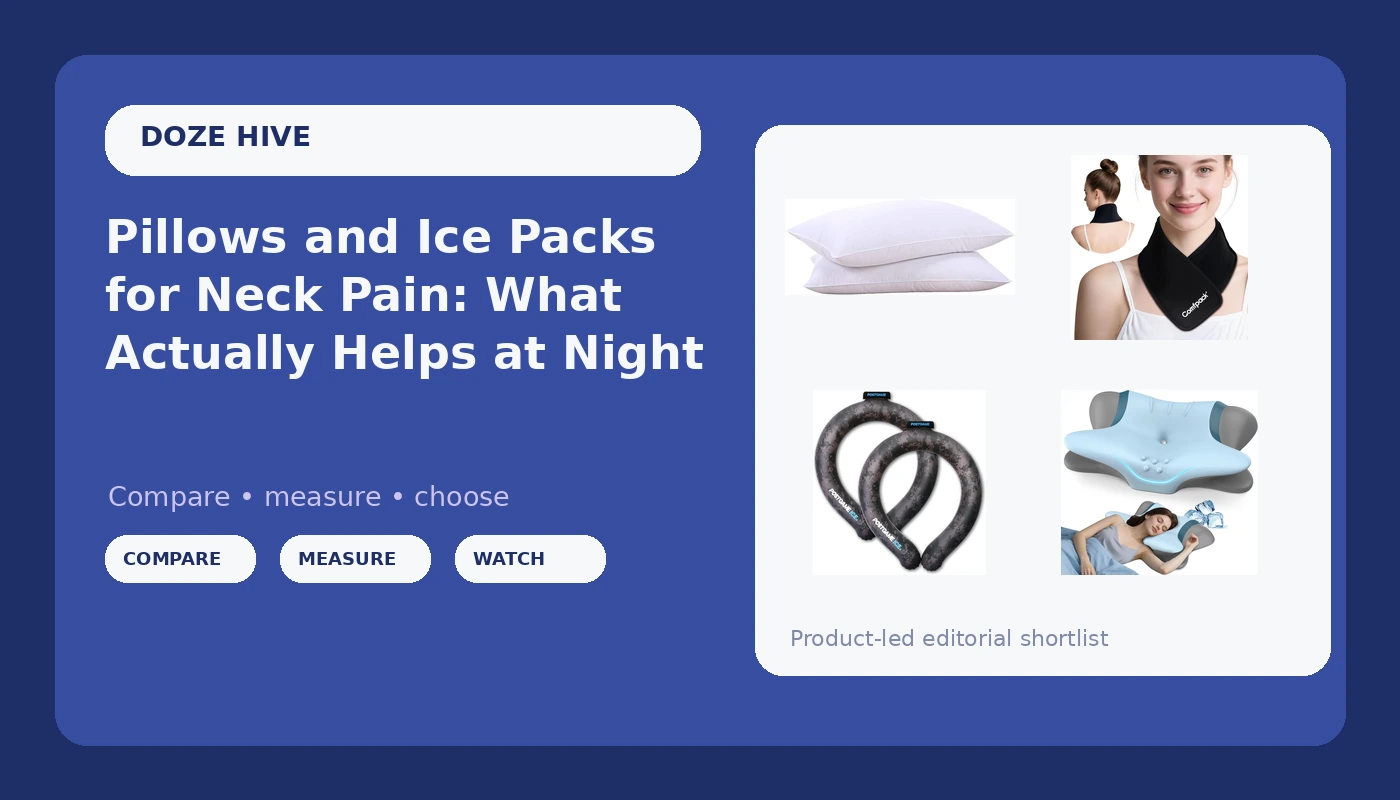
Morning neck stiffness is usually two problems wearing one name. The first is mechanical: the position your head, neck, and shoulders hold for seven or eight hours, which is a pillow question. The second is inflammatory: muscles and joints that are already irritated when you lie down, which is a cold-therapy question. Searches for pillows and ice packs for neck pain tend to surface both kinds of products on the same results page even though they do completely different jobs. One holds alignment through the night. The other calms irritated tissue before bed or after you wake up. This guide separates the two jobs, then walks through four options that cover the main ways people handle a sore neck, from contoured foam to a soft feather and down set to two reusable gel wraps.
Related: How to Choose a Pillow for Side Sleepers →
Quick answer
Start with your sleep position, because it decides almost everything else. Side and back sleepers who wake up stiff generally do best with a pillow that keeps loft under the neck instead of letting the head sink flat, and a contoured memory foam pillow is the most direct version of that. If your neck is already sore, a reusable gel wrap used cold handles the part a pillow cannot reach. Sleepers who want a soft, lofty, hotel-style pillow rather than contouring are better served by a goose feather and down set. Most people end up with one pillow and one wrap, not four products.
Four useful options
| Model | Best fit | What stands out |
|---|---|---|
| Cervical Pillow for Neck Pain Relief, Ergonomic Neck Pillow for Sleeping, Orthopedic Side Sleeper Pillow for Neck Support, Cooling Memory Foam Pillows Contour Pillow for Back Stomach Sleepers (Blue) | Side, back, and stomach sleepers who want contoured support | Contoured memory foam with a cooling cover, listed for all three sleep positions |
| puredown® Goose Feathers and Down White Pillows with 100% Cotton Cover, Bed Sleeping Hotel Collection Pillows Set of 2, Standard Size | Sleepers who want a soft, lofty hotel-style pillow | Goose feather and down fill in a 100% cotton cover, sold as a set of two |
| rituo Postgame Cooling Neck Wrap, Reusable Gel Ice Pack, L/XL (Pack of 2) | Larger necks and repeated cooling sessions | Reusable gel wrap in L/XL sizing, two per pack |
| Comfpack Neck Ice Pack Wrap, Flexible Gel Ice Pack for Neck, Wrists, Head | Targeted cold therapy on the neck, wrists, or head | Flexible gel wrap shaped to contour around smaller areas |
The contoured support pick: Cervical Pillow for Neck Pain Relief, Ergonomic Neck Pillow for Sleeping, Orthopedic Side Sleeper Pillow for Neck Support, Cooling Memory Foam Pillows Contour Pillow for Back Stomach Sleepers (Blue)
Contour pillows live or die on how the shape lines up with your body, and the honest trade-off is that a contour that fits one sleeper perfectly can feel like a speed bump to another. Side sleepers need enough loft to fill the gap between the neck and the mattress, which is roughly the width of a shoulder. Back sleepers need a cradle that keeps the chin from tipping toward the chest. Stomach sleepers need the lowest profile of the three, and a pillow advertised for all three positions is really a compromise that leans toward whichever position you spend most of the night in. Two more things worth knowing: memory foam warms up and softens as the night goes on, so the feel at 11 p.m. is not the feel at 3 a.m., and a cooling cover addresses the surface fabric, not the foam underneath it. If you sleep hot, judge that claim over several nights rather than one.
The hotel-style down pick: puredown® Goose Feathers and Down White Pillows with 100% Cotton Cover, Bed Sleeping Hotel Collection Pillows Set of 2, Standard Size
Feather and down behaves nothing like foam, and that is either the reason you want it or the reason you should skip it. It compresses under the head, so it molds instead of resisting, which many sleepers find comfortable and others find too soft by 2 a.m. Because the fill shifts, a down pillow needs a good shake most mornings to redistribute what migrated overnight, and a flat spot can develop under the neck if you never fluff it. Side sleepers sometimes need two of these stacked, or a folded one, to reach the loft a shoulder gap requires. The cotton cover matters more than people expect: it is breathable, but it is also a plain woven fabric, so a pillow protector is worth considering if you want to keep the casing clean between washes. If you want a pillow you never have to think about, a down set is the wrong personality. If you want the one that feels like a nice hotel, it is the right one.
The larger reusable wrap: rituo Postgame Cooling Neck Wrap, Reusable Gel Ice Pack, L/XL (Pack of 2)
Two wraps in one pack is more useful than it first sounds, because a gel pack that has been sitting on your neck for twenty minutes is no longer cold, and swapping in a second one from the freezer beats waiting for the first to refreeze. Sizing is the other thing to think about: L/XL coverage is helpful across the back of the neck and the tops of the shoulders, but a larger wrap is also heavier and can feel bulky if you are trying to lie down with it. Gel does not stay cold forever, and it does not stay pliable at freezer temperatures the way some people expect, so give it a few minutes on the counter before use. Standard cold-therapy practice is to keep sessions short, never apply a frozen pack directly to bare skin, and always use a thin cloth in between. A wrap like this is for the twenty minutes before bed, not for sleeping through the night on.
The flexible targeted wrap: Comfpack Neck Ice Pack Wrap, Flexible Gel Ice Pack for Neck, Wrists, Head
The case for a flexible wrap over a larger one is contact. Cold therapy works where the pack actually touches you, so a pliable pack that follows the curve behind the neck or wraps a wrist gives more useful contact than a rigid rectangle balanced on top. That also makes it the more versatile of the two wraps: the same pack can go on a wrist after a long day of typing or across the forehead during a headache, which is why it earns its place even in a house that already owns a bigger neck wrap. The trade-offs are coverage and duration. It covers a smaller area than an L/XL wrap, and like any gel pack it warms up and needs to go back in the freezer. If you want one cold pack that does a bit of everything rather than one that blankets the whole neck, this is the shape to pick.
Prices and availability change. Check the current listing for size, fill, and care details before ordering.
Why a pillow and a cold wrap do different jobs
It helps to think about the timeline of a sore neck. During the day, posture, screen angle, and how you carry a bag all load the muscles around the cervical spine. By evening, that tissue may be tight or irritated. Overnight, the only thing holding your head is your pillow, and whatever position it puts your neck in is the position your neck holds for hours. In the morning, you feel the sum of both.
A pillow is a mechanical tool. It changes the angle of your head relative to your spine, which is why loft, firmness, and shape matter more than thread count or a nice-looking cover. A cold wrap is a comfort tool. It does not change alignment at all; it addresses the irritation you brought to bed with you. Neither one substitutes for the other, and buying a better pillow will not fix a neck that is already angry tonight.
This is also why cooling claims deserve a skeptical eye. A cooling cover, a cooling gel layer, and a breathable fill are three different things, and the phrase on the packaging rarely tells you which one you are getting. The practical test is simple: sleep on it and notice whether you are pushing the pillow away at 2 a.m. If you are, the cover is not doing the job the label implied.
How to narrow down your options
- Log your sleep position for three nights before you buy anything. Side, back, and stomach need different loft, and most people are wrong about which one they spend the night in.
- Notice the gap. In your usual position, estimate the space between the side of your neck and the mattress. A pillow has to fill that gap without pushing your head up or letting it drop.
- Decide what you are actually solving. If mornings are stiff but your neck feels fine at bedtime, that is a support problem. If your neck is already tight or sore when you get into bed, that is a cold-therapy problem, and possibly both.
- Read the fill and the casing, not the adjectives. Fill type, fill amount, and cover fabric tell you more than "hotel quality" or "premium" ever will.
- Give anything new two full weeks, and follow the maker's directions for freezing a gel pack. A pillow judged on night one is a pillow judged unfairly, especially if it arrived vacuum sealed.
Practical notes for the first two weeks
- Let a vacuum-sealed pillow plump for a full 48 hours before you judge it. Night one is not a fair test of anything.
- Fluff and rotate your pillow once a week so fill does not migrate into one corner and leave a flat spot under your neck.
- Keep a gel wrap in the freezer inside a resealable bag so it is ready when you need it, and keep a spare cold if you have a two-pack.
- Put a thin cloth between your skin and a frozen wrap, and keep sessions short rather than falling asleep with it on.
- Score your neck each morning from 1 to 10 and write it down. A week of notes beats a memory of how you think you slept.
Which option should you choose?
Choose the Cervical Pillow for Neck Pain Relief, Ergonomic Neck Pillow for Sleeping, Orthopedic Side Sleeper Pillow for Neck Support, Cooling Memory Foam Pillows Contour Pillow for Back Stomach Sleepers (Blue) when you want contoured support and you are willing to spend a couple of weeks dialing in the position that suits you. Choose the puredown® Goose Feathers and Down White Pillows with 100% Cotton Cover, Bed Sleeping Hotel Collection Pillows Set of 2, Standard Size when you want a soft, moldable pillow and do not mind fluffing it daily. Choose the rituo Postgame Cooling Neck Wrap, Reusable Gel Ice Pack, L/XL (Pack of 2) when you want broad coverage across the neck and shoulders with a spare always ready in the freezer. Choose the Comfpack Neck Ice Pack Wrap, Flexible Gel Ice Pack for Neck, Wrists, Head when you want one flexible pack that contours to the neck, a wrist, or your head instead of a single large wrap.
A caveat worth stating plainly: nothing here is medical advice. A pillow and a cold pack are comfort tools, and they work alongside whatever your clinician recommends, not instead of it. Persistent neck pain, numbness, or pain that travels down an arm is a conversation to have with a professional, not a shopping decision.
The bottom line
Most people treat a sore neck as one problem and buy one product for it. It is really two problems with two different fixes. Support under the neck overnight is a pillow decision, driven by your sleep position and how much loft your shoulder gap demands. Discomfort you are already carrying into bed is a cold-therapy decision, and a reusable gel wrap handles it in twenty-minute stretches. Match the pillow to your position, keep a wrap cold in the freezer, and judge both over two weeks of nights rather than one. That is a far more reliable path than chasing whichever pillow currently has the loudest reviews.