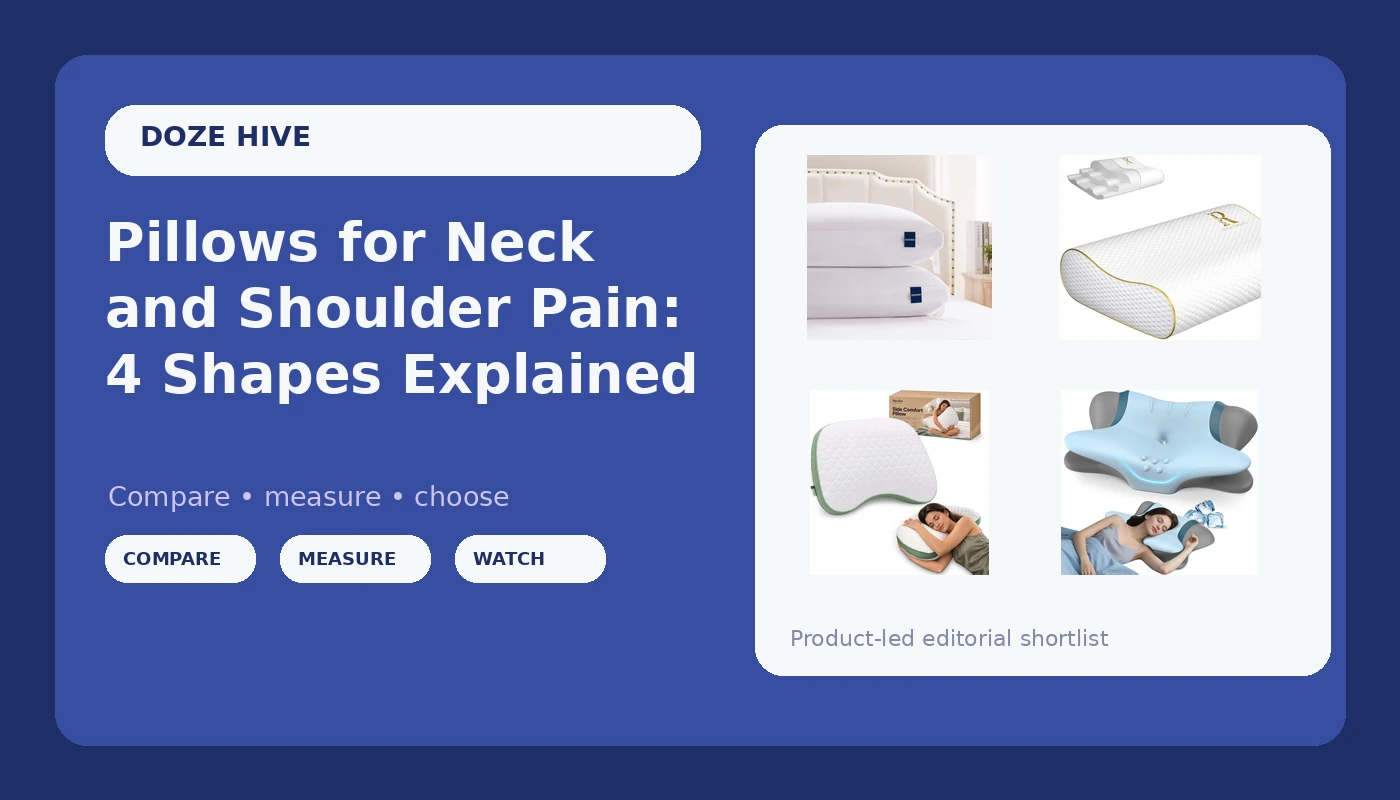
Neck and shoulder pain that greets you in the morning is usually a geometry problem, not a mattress problem. Your head needs to sit roughly in line with your spine, and the pillow has to hold that position for seven or eight hours without collapsing under the weight of your neck. That is a lot to ask of a bag of fill, which is why pillows for neck and shoulder pain come in so many shapes: adjustable, contoured, hybrid, cooling, and everything in between. The labels are not much help. "Orthopedic" and "ergonomic" get printed on pillows that go flat by month three, and "cooling" shows up on covers wrapped around fill that still sleeps warm. This guide breaks down four specific options, what shape each one uses, and which sleeper each shape tends to suit, so you can narrow the field before you spend money on a guess.
Related: Memory Foam vs Down Pillows: How Fill Changes Loft →
Quick answer
Match the pillow to your sleep position first and your body second. Side sleepers need enough loft to fill the gap between the ear and the outer shoulder. Back sleepers need a lower profile with a shallow cradle under the neck curve. Stomach sleepers need the least height of the three. Among the options here, the Novilla pillow is built around side sleeping and lets you adjust the loft, the blue cervical contour pillow pairs an ergonomic shape with cooling memory foam, the ACCURATEX set gives you two adjustable hybrid pillows in one order, and the Royal Therapy pillow is a fixed queen size memory foam contour with a defined neck ridge. Each one suits a different sleeper, and none of them suits everyone.
Four useful options
Four shapes, four different jobs, and one shared rule: the pillow has to keep doing that job at 3 a.m., not just on the first night.
| Model | Best fit | What stands out |
|---|---|---|
| Novilla Adjustable Side Sleeper Pillow for Neck and Shoulder Pain Relief | Side sleepers who want to tune the loft | Adjustable design aimed at side sleeping specifically |
| Cervical Pillow for Neck Pain Relief, Ergonomic Neck Pillow for Sleeping, Orthopedic Side Sleeper Pillow for Neck Support, Cooling Memory Foam Pillows Contour Pillow for Back Stomach Sleepers (Blue) | Back and stomach sleepers who want a contour | Cooling memory foam in an ergonomic contour shape |
| ACCURATEX Standard Pillows Set of 2, Adjustable Hybrid Pillows 2 Pack | Couples, guest rooms, and hybrid fill fans | Two adjustable hybrid pillows in a single order |
| Royal Therapy Memory Foam Pillow, Queen Neck Pain Relief, Contour Cervical Pillow, for Neck and Shoulder Pain, Side, Back and Stomach Sleeper, 24x14x5 inches | Sleepers who want a fixed contour with a defined neck ridge | Queen size 24 x 14 x 5 inch contoured memory foam |
The adjustable side sleeper option: Novilla Adjustable Side Sleeper Pillow for Neck and Shoulder Pain Relief
Side sleeping is the position that punishes a bad pillow fastest, because the shoulder creates a gap that a flat pillow cannot fill. If the pillow is too low, the head drops and the neck bends sideways for hours. If it is too high, the neck tilts the other way and the shoulder gets pushed forward. An adjustable design gives you a way to close that gap yourself, which matters because shoulder width varies enormously from person to person. The trade off is that adjustable fill can shift, so you may find yourself redistributing it every few weeks, and a pillow with a tuning knob is only as good as the nights you spend tuning it. Give any adjustment two or three nights before you decide it was wrong.
The cooling contour option: Cervical Pillow for Neck Pain Relief, Ergonomic Neck Pillow for Sleeping, Orthopedic Side Sleeper Pillow for Neck Support, Cooling Memory Foam Pillows Contour Pillow for Back Stomach Sleepers (Blue)
Cooling is the most oversold word in bedding, so treat it as a claim to test rather than a feature you can bank on. A cooling cover can feel genuinely cool when you lie down and still leave you warm at 2 a.m., because the fill underneath is what traps heat. The honest way to judge it is to sleep on it warm, not cold, and notice whether you wake up and flip the pillow. Contour shapes have their own trade off too: the raised ridge that supports a back sleeper's neck curve can feel like a speed bump to someone who rolls onto their stomach, and stomach sleepers generally need the least height of anyone. If you move between positions during the night, a contour is a compromise by design.
The two pack option: ACCURATEX Standard Pillows Set of 2, Adjustable Hybrid Pillows 2 Pack
A set makes sense in more situations than people admit. Guest rooms need two pillows, couples rarely want identical loft, and a hybrid fill tends to sit between the two extremes of all foam and all fiber, which is exactly where a lot of sleepers land once they stop chasing a firmness label. The trade off with any two pack is that you cannot fine tune one pillow to one body the way you can with a single adjustable option, and hybrid fill can migrate toward the corners over months of use. Press the pillow flat with both hands and see whether the fill springs back evenly before you commit it to your bed rather than the guest room.
The fixed contour option: Royal Therapy Memory Foam Pillow, Queen Neck Pain Relief, Contour Cervical Pillow, for Neck and Shoulder Pain, Side, Back and Stomach Sleeper, 24x14x5 inches
A fixed contour is the least forgiving kind of pillow and also the most consistent. Nothing shifts, nothing needs redistributing, and the height you feel on night one is roughly the height you feel on night ninety, provided the foam holds up. That consistency is why contour pillows stay popular with people who wake with a stiff neck. The catch is that five inches of height is a lot for a stomach sleeper and about right for many side sleepers, so the same pillow can be perfect for one person in a bed and wrong for the person next to them. If you have never slept on a contoured pillow, the first two nights often feel strange before they feel good.
Prices and availability may change. Product images, names, and retailer links are matched to verified listings. No current price, rating, stock status, or measured result is stated here without current evidence.
Why pillow shape matters more than the word firm
Firmness is the least useful specification on a pillow listing. Two pillows can both be described as firm and behave completely differently, because firmness depends on fill type, fill weight, density, and how much of it is packed into the casing. What actually determines whether your neck hurts in the morning is height and shape: where the pillow touches your head, where it touches your neck, and whether it stays there.
That is why sleep position drives the decision. A side sleeper needs loft measured against shoulder width, so a broad shouldered person may need several inches more height than a narrow shouldered person in the same bed. A back sleeper needs a lower pillow with support under the neck curve and a shallow dip for the head. A stomach sleeper usually needs the flattest option available, sometimes almost nothing. A contour pillow bakes those zones into a fixed shape. An adjustable pillow lets you build the height yourself. Neither approach is better in the abstract, but one will fit your body and one may not.
Cooling deserves the same skepticism as firmness. A breathable cover, a gel layer, and a genuinely open cell foam all do different things, and only some of them help a warm sleeper stay asleep. The test is simple: does the pillow feel warm in the middle of the night, not in the first five minutes.
How to test a pillow without wasting a month
- Let it plump. Most pillows ship vacuum sealed and flat. Give it a full 48 hours to expand before you judge the loft, even though the temptation to sleep on it the first night is real.
- Sleep one night in your primary position only. If you are a side sleeper, do not test the back position on night one. You want a clean read on the position you use most.
- Rotate through your other positions on nights two and three. Note whether the height that felt right on your side is too tall when you roll onto your back.
- Log the morning, not the memory. Write down neck pain on a simple one to ten scale and how many times you woke up. Two weeks of notes beats a vague impression every time.
- Check the loft at the end of week two. Press the middle with your palm and compare it to the edges. Fill that has already migrated or compressed is a preview of month six.
What to check before you order
- The return window, and whether the pillow has to be in original packaging to qualify.
- Whether the cover is removable, and what the listing says about washing it.
- The listed dimensions, and whether they fit your pillowcases and your bed frame.
- Whether the pillow is sold as one or as a set, since the per pillow math changes the value.
- The cost per year rather than the cost today. A pillow that lasts five years is cheaper than three that last eighteen months.
- Any cooling claim, and whether the listing describes the cover, the fill, or both.
Which option should you choose?
Choose the Novilla Adjustable Side Sleeper Pillow for Neck and Shoulder Pain Relief when you sleep mostly on your side and want to tune the loft to your own shoulder width. Choose the Cervical Pillow for Neck Pain Relief, Ergonomic Neck Pillow for Sleeping, Orthopedic Side Sleeper Pillow for Neck Support, Cooling Memory Foam Pillows Contour Pillow for Back Stomach Sleepers (Blue) when you want a contour shape with a cooling memory foam build and you split your nights between your back, your stomach, and your side. Choose the ACCURATEX Standard Pillows Set of 2, Adjustable Hybrid Pillows 2 Pack when you need two pillows, are furnishing a guest room, or want adjustable hybrid fill for two sleepers with different preferences. Choose the Royal Therapy Memory Foam Pillow, Queen Neck Pain Relief, Contour Cervical Pillow, for Neck and Shoulder Pain, Side, Back and Stomach Sleeper, 24x14x5 inches when you want a fixed queen size contour with a defined neck ridge and no fill to rearrange.
None of these is a medical device, and none of them will fix a disc issue or a pinched nerve. If your neck pain comes with numbness, tingling, or headaches that do not improve, that is a conversation for a clinician, not a pillow review. What a pillow can realistically do is remove one nightly source of strain so the rest of your setup has a chance to work.
The bottom line
Buy the shape, not the adjective. Work out your sleep position, measure how much loft that position needs, and pick the pillow whose geometry matches. An adjustable design is the safest first purchase if you are unsure, a two pack is the practical answer when more than one sleeper is involved, and a fixed contour is the most consistent option if the dimensions already fit you. Then give whichever one you order two full days to plump, two weeks of logged nights in every position you sleep in, and a fair judgment at the end. That process costs you nothing but patience, and it is the difference between a pillow that solves the problem and one that gets returned.