If you wake up at 2 a.m. with a damp neck and a pillow flattened under your ear, you have probably already searched for cooling pillows for hot sleepers and scrolled past a hundred listings that promise the same thing. Here is the problem: cooling is the second question, not the first. The first question is whether a pillow holds the right height for the way you sleep, because one that sits too low for a side sleeper will wake you up just as reliably as one that traps heat. Get the loft and the fill wrong and no cover fabric will rescue the night. Get them right and a pillow quietly disappears under your head for years, which is the entire point of amortizing a purchase over its lifespan instead of replacing a flat bargain pillow every eight months.
Related: How to Plump a Vacuum-Sealed Pillow and Test Its Loft →
Quick answer
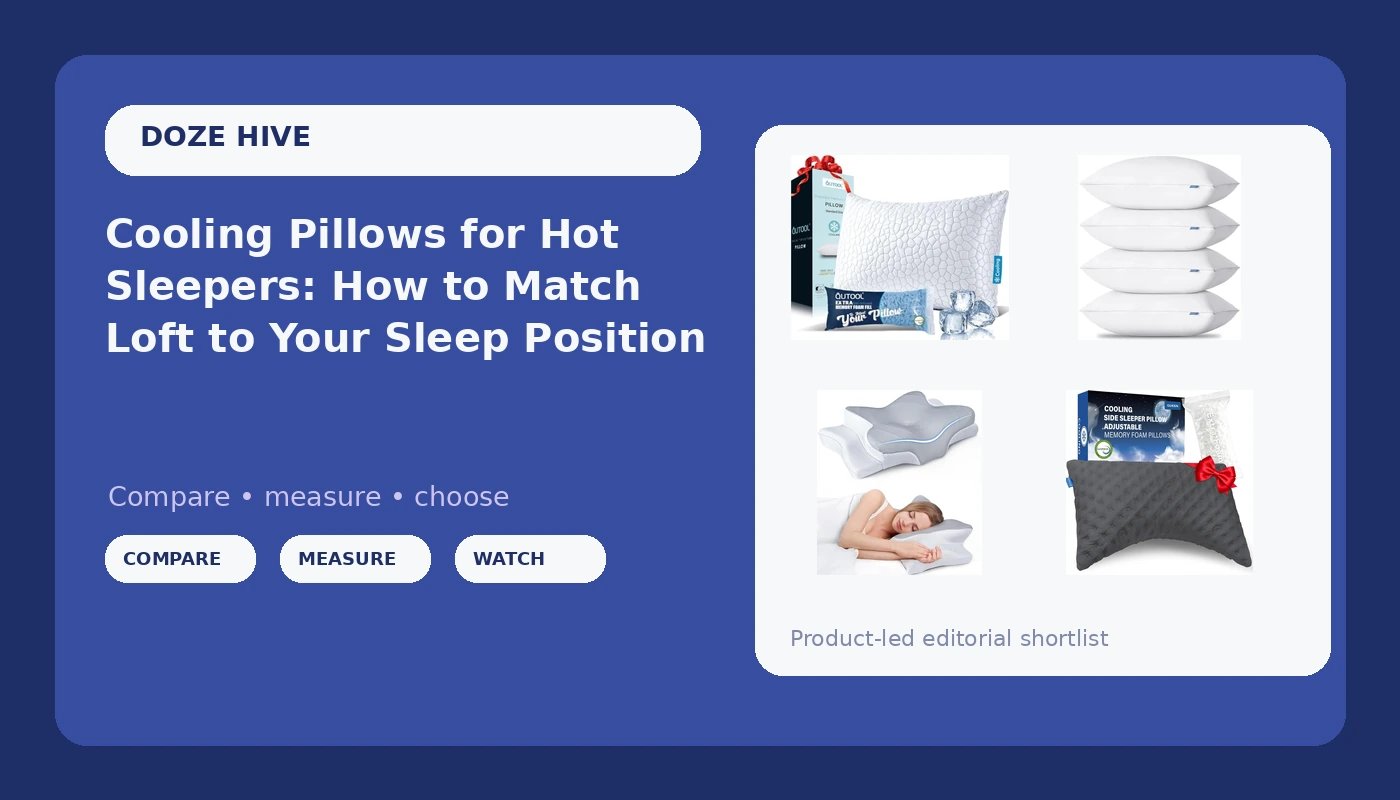
The pillow that fixes your sleep is the one whose height and fill match your dominant position, not the one with the loudest cooling claim. Side sleepers need a taller, more supportive pillow that fills the gap between the ear and the shoulder. Back sleepers usually do better with a medium, contouring pillow that follows the natural curve of the neck. Stomach sleepers need something low and soft so the head does not tilt back all night. The four options below split along those lines: a curved shredded foam pillow shaped for side sleeping, a contour cervical pillow for neck support, an adjustable shredded foam pillow that can be tuned for any of the three positions, and a set of four medium support queen pillows that suits a guest room or a whole bed.
4 useful options
| Model | Best fit | What stands out |
|---|---|---|
| KUCEY Cooling Side Sleeper Pillow for Neck and Shoulder Pain | Side sleepers who want the shoulder gap filled | Curved crescent shape, shredded memory foam, adjustable loft, washable cover |
| Ultra Pain Relief Cooling Pillow for Neck Support | Back sleepers and anyone chasing neck support | Ergonomic contour memory foam, adjustable, described as odorless |
| QUTOOL Cooling Pillow for Sleeping | Sleepers who want one pillow that can be tuned per position | CertiPUR-US shredded memory foam, adjustable firmness, sold as a single standard pillow |
| CozyLux Bed Pillows Queen Size Set of 4 | Guest rooms and anyone replacing a whole bed at once | Four queen pillows, 18 by 28 inches, medium support |
Side sleeper option: KUCEY Cooling Side Sleeper Pillow for Neck and Shoulder Pain
Side sleeping is a geometry problem before it is a comfort problem. When you lie on your side, your head needs enough height to keep the neck roughly level with the spine, and the space between your ear and the mattress edge is exactly where a flat pillow fails. A curved pillow gives your shoulder somewhere to go instead of forcing your head forward or back. The trade-off is adjustability versus consistency: shredded fill lets you add or remove material until the height feels right, but shredded fill also needs a shake in the morning to redistribute, and it can compress unevenly over time. A stomach sleeper should leave this shape alone, since the curve is doing the opposite of what a stomach sleeper needs.
Neck support option: Ultra Pain Relief Cooling Pillow for Neck Support
Contour pillows are the most position-specific category in bedding, because the shape is fixed and they only work if the ridges land where your neck actually sits. The advantage over shredded fill is that the loft never migrates, so the height you feel on night one is roughly the height you feel in month six. The catch is that a molded contour does not negotiate: if your shoulder width or sleeping angle puts the ridge in the wrong place, there is no removing fill to fix it. That makes the return window genuinely important here, and it is the reason a contour pillow should be tried in all three positions before it earns a permanent spot on the bed.
Prices and availability may change. Product images, names, and retailer links must be matched by verified ASIN. Do not state a current price, rating, stock status, or measured result without current evidence.
All-position option: QUTOOL Cooling Pillow for Sleeping
An adjustable pillow is the closest thing to a test drive in a box, and it is the safest option if two people of different sizes share a bed or if you genuinely sleep in more than one position during the night. You can make it taller for side sleeping by pushing fill toward the front, or flatter for back sleeping by removing some. Two caveats are worth stating plainly. First, standard size is narrower than queen, so check what your pillowcase and bed actually use. Second, an adjustable pillow is only as good as its fill content: one that arrives half empty stays half empty no matter how much you fluff it. Fill weight is the number to look at, not the word "firm."
Guest room option: CozyLux Bed Pillows Queen Size Set of 4
Guest rooms are where a medium support set makes the most sense, because you cannot ask every visitor about their sleep position and you are not going to stock four different pillows for four different people. The trade-off is obvious: a generic medium pillow is nobody's perfect pillow. A stomach sleeper will find it too tall, a broad-shouldered side sleeper will find it too low, and a back sleeper will probably find it fine. That is an acceptable compromise for a room used a few nights a month, and a poor one for the pillow you sleep on 365 nights a year, which is exactly how cost-per-year thinking should separate the two purchases.
Loft, fill, and why your sleep position sets the spec
Every pillow decision starts with a measurement you take without a ruler. Lie on your side on your mattress and look at the gap between your ear and the bed. That gap is the loft your pillow has to fill. Lie on your back and the requirement changes, because now the pillow is supporting the curve of your neck rather than the width of your shoulders, and the target height drops. Lie on your stomach and it drops again, because anything thick tilts your head back and forces your neck into extension for hours.
This is why fill type matters as much as fill amount. Shredded memory foam can be added to and removed from, so it adapts to a gap you cannot measure precisely. Molded contour foam is fixed but consistent, so it either fits your shape on night one or it never will. Down alternative clusters are lightweight, breathe well, and read as cloud-like, but they compress under the head and lose height as the night goes on. Buckwheat hulls hold their shape with real heft and won't go flat, though they crunch like a bag of cereal for the first week and settle over years of use. None of these is universally right. Each one is right for a particular body and a particular position.
There is also the flattening question, and it is the one listings rarely answer. A pillow that starts at the right height and loses it by month three was never a good buy, no matter what it cost. That is where amortizing helps: divide the purchase by the realistic number of years it will hold its loft, and the comparison between a cheap pillow replaced every year and a better-built one kept for five stops being about price tags at all.
What "cooling" actually means on a pillow label
Cooling is the most overused word in bedding, and the honest answer is that most of it describes the cover, not the fill. A cooling cover can be a genuinely breathable fabric with real moisture-wicking behavior, or it can be a standard polyester shell with a blue gradient on the packaging. Either way, the cover is only the outer inch of a pillow that is stuffed with foam, and foam holds heat. Shredded fill with air between the pieces generally breathes better than a solid molded block, which is one reason side and back sleepers who run warm often gravitate toward shredded options.
For a warm sleeper, the practical test happens around 2 a.m., not at bedtime. Falling asleep cool is easy. Staying cool through the second half of the night, when body temperature regulation is at its most fragile, is the real measure, and it is the reason a cooling claim should be treated as a starting point rather than a promise. If you sleep hot and use a CPAP machine, heat and head position interact: a pillow that props your head too high can shift mask fit, and a pillow that lets your head sink can do the same. That is a fit question for you and your clinician, not a claim any listing can settle.
How to choose in five steps
- Identify your dominant sleep position honestly, counting the position you wake up in, not the one you fall asleep in.
- Estimate your loft gap by lying on your side on your own mattress and noting how much space sits between your ear and the bed.
- Decide whether you want adjustable fill you can tune or a fixed contour you can trust, since those are opposite strengths.
- Check the fill details you can verify in the listing, including fill type, any certification such as CertiPUR-US, and the size of the pillow against your pillowcase.
- Give a vacuum-sealed pillow two full days to plump, then test it in all three positions across at least two weeks before you decide to keep it.
Practical guidance
- Give any vacuum-sealed pillow two days to fully expand, and resist sleeping on the pancake version on night one even if you are impatient.
- Wash according to the care instructions for the specific cover, and expect a wash to be the truest stress test of stitching and casing quality.
- Shake shredded fill back into place each morning so it does not migrate to one corner and leave a flat spot under your neck.
- Air out any new foam pillow before it goes on the bed, since off-gassing odor is a dealbreaker when it lingers past the first week.
- Keep the return window in mind, because a pillow that fails the side, back, and stomach check is a return, not a spare.
Which option should you choose?
Choose the KUCEY Cooling Side Sleeper Pillow for Neck and Shoulder Pain when you sleep on your side and want a curved shape with fill you can adjust. Choose the Ultra Pain Relief Cooling Pillow for Neck Support when neck support is the priority and you want a fixed contour that will not shift overnight. Choose the QUTOOL Cooling Pillow for Sleeping when one pillow has to work across positions or across two different sleepers. Choose the CozyLux Bed Pillows Queen Size Set of 4 when you are outfitting a guest room or replacing every pillow on a queen bed at once.
A caveat worth repeating: listings describe the pillow on day one. None of them can tell you how the fill behaves in month twelve, how much fill is actually inside the casing, or whether the cooling cover makes a measurable difference for your body. Those answers come from your own nights, which is why the two-week test and the return window matter more than any single bullet point in a product description. This is general guidance about pillows, not medical advice about neck pain or sleep apnea.
The bottom line
Cooling pillows for hot sleepers are a real category, but cooling is the last filter, not the first. Match the loft to your sleep position, choose a fill you can live with, check whether the pillow is adjustable or fixed, and confirm the size against your bed and pillowcases. Then let the cover and the breathability claims break the tie. Amortized over the years a pillow actually lasts, the right one costs less than replacing a flat bargain pillow every season, and it does not wake you up at 2 a.m.