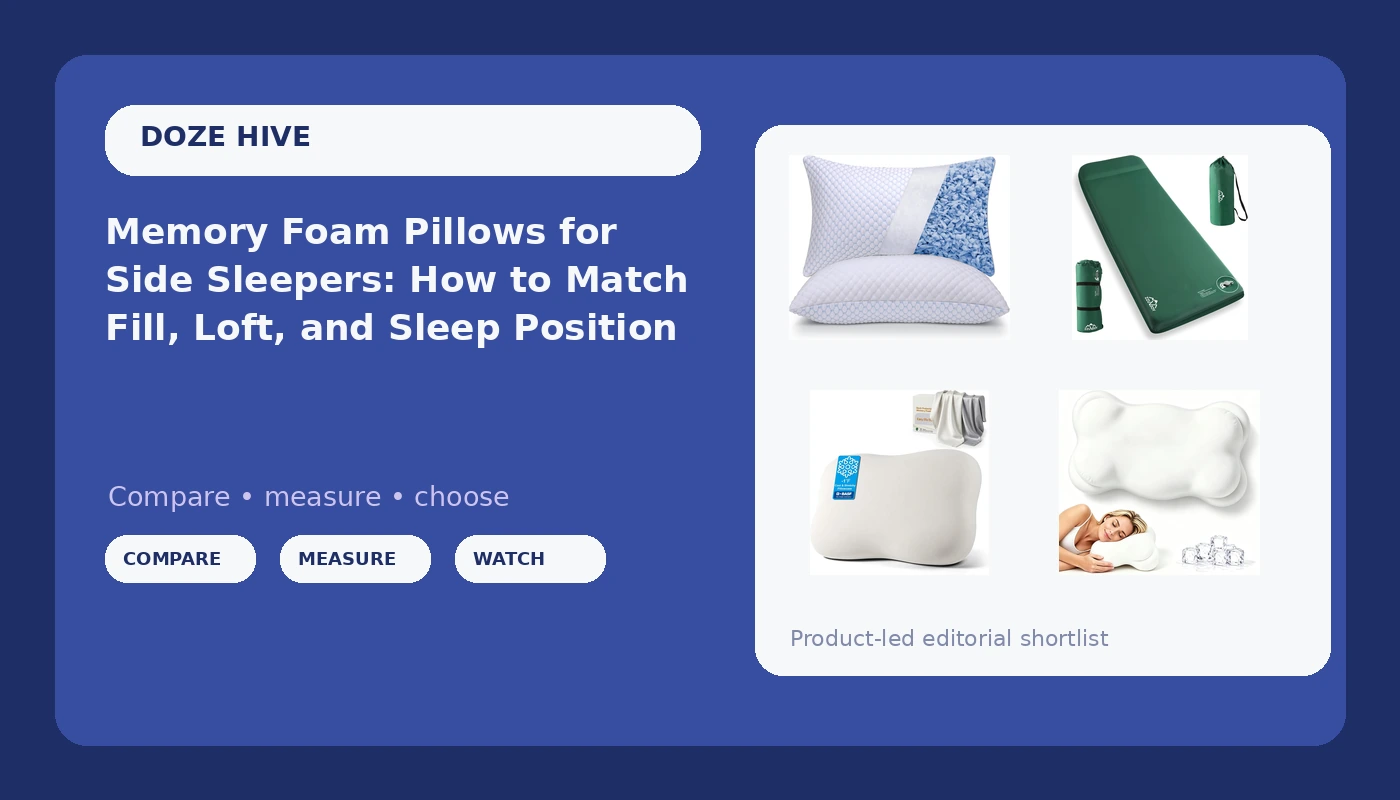
If you sleep on your side, the space between your ear and your shoulder is the entire problem, and memory foam pillows for side sleepers only work when the fill, the loft, and the shape actually fill that space. Too thin and your head drops, your neck bends sideways, and you wake up at 2 a.m. fluffing something that went flat hours ago. Too tall and you spend the night with your chin pushed toward your chest. I have slept on pillows in three positions for years, because my husband Tom is a lifelong side sleeper, I sleep on my back, and our guest bed regularly gets stomach sleepers. This explainer walks through four current memory foam options, what each one is genuinely built for, and how to decide before you order instead of after you return.
Related: How to Pick a Pillow for Your Sleep Position →
Quick answer
Match the pillow to your position first and to the fill second. Side sleepers generally need the tallest loft and the most contour, back sleepers need moderate loft with steady neck support, and stomach sleepers need the flattest profile available. Among the four options here, the OSBED set covers a queen bed with shredded memory foam, the contour cervical pillow is shaped specifically around side sleeping, the Cloud Align pillow offers cervical shaping in a softer profile, and the memory sleeping pad handles nights that are not happening on a mattress at all.
4 useful options
| Model | Best fit | What stands out |
|---|---|---|
| OSBED Shredded Memory Foam Pillows Queen Size Set of 2 | Back and combination sleepers, and anyone outfitting a whole bed | Shredded memory foam fill, queen size, sold as a set of two |
| Cervical Neck Pillow, Contour Memory Foam Pillow for Side Sleepers | Side sleepers who want a shaped neck channel | Contour memory foam built around the side-sleeping position |
| Cloud Pillow, Cloud Align Pillow for Sleeping Cervical Neck | Sleepers who want cervical shaping without a firm block | Cloud Align cervical design with a softer profile |
| Memory Sleeping Pad, 3.1" Ultra-Thick Foam Sleeping Mats for Camping, 9.5 R-Value Insulated Self Inflating Sleeping Pad with Pillow, Camping Mattress Pad for Car Travel Tent | Guest floors, camping, car travel, and spare-room overflow | Self-inflating foam pad with an integrated pillow, listed at a 9.5 R-value |
Queen bed coverage: OSBED Shredded Memory Foam Pillows Queen Size Set of 2
Shredded fill and molded fill behave like two different materials even though both are memory foam. A molded block holds one shape and one height no matter what you do to it. A shredded fill is loose inside the casing, which means it shifts as you move and settles where your head puts it. That is why shredded pillows often suit combination sleepers who roll from back to side during the night, and why they can feel uneven to someone who wants the same support at 10 p.m. and 4 a.m. This listing is a queen size set of two, so it makes sense for a full bed rather than a single replacement pillow. As with any vacuum-sealed foam, give it time to plump before you judge the loft. I tell everyone two days. I also slept on the flat version the first night anyway, so do as I say.
Contour support for side sleeping: Cervical Neck Pillow, Contour Memory Foam Pillow for Side Sleepers
Contour pillows are the most position-specific thing in bedding, and that is both the point and the catch. The shape gives your neck somewhere to rest instead of leaving it to hang in the gap above the mattress, which is the whole reason side sleepers wake up with a stiff neck. The trade-off is that a contour that fits one person's shoulder width can push another person's chin up. This pillow is designed around side sleeping, so if you flip onto your back halfway through the night, expect to feel the difference. If you use a CPAP mask, the mask and hose are the first thing to check against any new shape, and that is a conversation for your clinician, not for me. What I will say is that head and neck position changes how a mask sits, so test a new contour on a night when you can afford to be tired.
Softer cervical shaping: Cloud Pillow, Cloud Align Pillow for Sleeping Cervical Neck
Not everyone wants a neck channel that feels like a piece of furniture. A softer cervical pillow is the middle ground: it still has a shape meant to support the neck, but the feel is closer to a traditional pillow than to a dense contour block. That is a real preference, not a downgrade. It suits back sleepers who want a little neck support, side sleepers with narrower shoulders, and anyone who has tried a firm contour and hated the pressure under the jaw. The honest trade-off is loft hold. A softer pillow has less material resisting your head, so if you are a broad-shouldered side sleeper who needs the gap filled all night, a softer profile may compress more than you want. This is exactly the kind of claim you cannot settle from a listing photo, which is why firmness language on the box means very little to me until I have pressed on it myself.
For nights off the bed: Memory Sleeping Pad, 3.1" Ultra-Thick Foam Sleeping Mats for Camping, 9.5 R-Value Insulated Self Inflating Sleeping Pad with Pillow, Camping Mattress Pad for Car Travel Tent
This one belongs in the group for a reason that has nothing to do with your bed at home. It is a sleeping pad, which means it solves the problem underneath the pillow: a hard floor, a guest room with no spare bed, a tent, or a car seat reclined in a rest area. The listing describes a self-inflating foam pad with a built-in pillow, 3.1 inches of thickness, and a 9.5 R-value, and R-value is the number that speaks to insulation from cold ground rather than comfort. If you are setting up a guest room for overflow or you camp a few weekends a year, this fills a gap that no pillow can. What it will not do is replace a mattress, and the integrated pillow is a convenience, not a substitute for the shaped support the other three options here are built around.
Prices and availability may change. Product images, names, and retailer links are matched to verified listings. No current price, rating, stock status, or measured result is stated here without current evidence.
Why your sleep position decides the pillow
Pillow shopping goes wrong when people buy for the bed instead of for the body. A side sleeper's head sits roughly a shoulder's width above the mattress, so the pillow has to fill that vertical gap or the neck bends down toward the mattress all night. A back sleeper needs much less height and more support at the base of the neck, because the spine wants to keep its natural curve. A stomach sleeper needs almost nothing, since any real loft rotates the head and twists the neck. That is three different pillows from one mattress, and it explains why one couple can love the same pillow for opposite reasons, or hate it for opposite reasons.
Then there is movement. Most people change position during the night, so the pillow that fits you at midnight has to still fit you at 3 a.m. A pillow that only works in one position is not a bad pillow, but the review should say so instead of pretending otherwise. If you share a bed with someone whose position differs from yours, buy for each person separately rather than compromising on a pillow that half-fits both of you.
Shredded fill, molded contour, and what the labels do not tell you
Shredded memory foam is loose fill inside a casing, so it moves and compresses unevenly. Molded memory foam holds a fixed shape. Neither is superior; they simply fail differently. Shredded fill can migrate to one corner by morning and leave a flat spot under your neck. Molded foam can feel perfect on night one and progressively firmer as the material responds to your body heat.
Two label claims deserve skepticism. The first is firmness. I have ordered pillows advertised as firm that arrived very soft and thin, which is why I now check fill weight and press on the pillow myself before trusting any adjective on the packaging. The second is cooling. A cooling cover is a fabric claim, and it says nothing about whether the foam inside traps heat. If you sleep warm, the cover is not the test; the fill is, and the only way to know is a warm night in your own bed.
Also plan for the first 48 hours. Most foam pillows arrive vacuum sealed and flat, and they need time to plump back to their advertised loft. If a pillow is still pancaked on day three, that is information.
Here is the sequence I use before I buy anything:
- Identify your primary sleep position and how often you change it during the night.
- Measure the gap between your ear and the mattress edge when you lie on your side.
- Decide whether you want a fixed molded shape or a fill that shifts with you.
- Check the fill weight and casing quality instead of trusting a firmness word.
- Divide the price by the years you expect it to last before you call it expensive.
Practical guidance before you order
- Give any vacuum-sealed pillow a full 48 hours to expand before you decide it is too flat.
- Air out a new foam pillow somewhere ventilated; a chemical odor that lingers past a week is a real reason to return it.
- Check the loft at month three and month twelve, because that is when foam and cheap fills start going flat.
- Wash according to the care label and dry thoroughly, since a damp fill is how pillows develop odors that never leave.
- For a guest room, keep a reasonably priced pillow that suits most sleepers rather than a specialty shape that only fits one body.
Which option should you choose?
Choose the OSBED Shredded Memory Foam Pillows Queen Size Set of 2 when you are outfitting a queen bed and want shredded fill on both sides without buying two separate pillows. Choose the Cervical Neck Pillow, Contour Memory Foam Pillow for Side Sleepers when side sleeping is your primary position and you want a shaped contour under the neck. Choose the Cloud Pillow, Cloud Align Pillow for Sleeping Cervical Neck when you want cervical shaping in a softer, less rigid profile. Choose the Memory Sleeping Pad, 3.1" Ultra-Thick Foam Sleeping Mats for Camping, 9.5 R-Value Insulated Self Inflating Sleeping Pad with Pillow when the problem is the surface underneath you, not the pillow on top of it.
One caveat on all four: none of these listings can tell you how a pillow will feel against your own shoulder width, and none of my notes can predict your neck. Fit is personal, and the return window is part of the purchase.
The bottom line
Memory foam pillows for side sleepers are a fit problem before they are a material problem. Get the loft and the shape right for your primary position, then choose between shredded fill and a molded contour based on whether you move at night. A contour shaped for side sleeping, a softer cervical profile, a queen set of two, and a self-inflating pad for nights off the mattress each solve a different version of the same complaint. Amortize the cost over the years you expect to keep it, check the fill instead of the marketing word, and give the pillow two nights before you decide it failed.