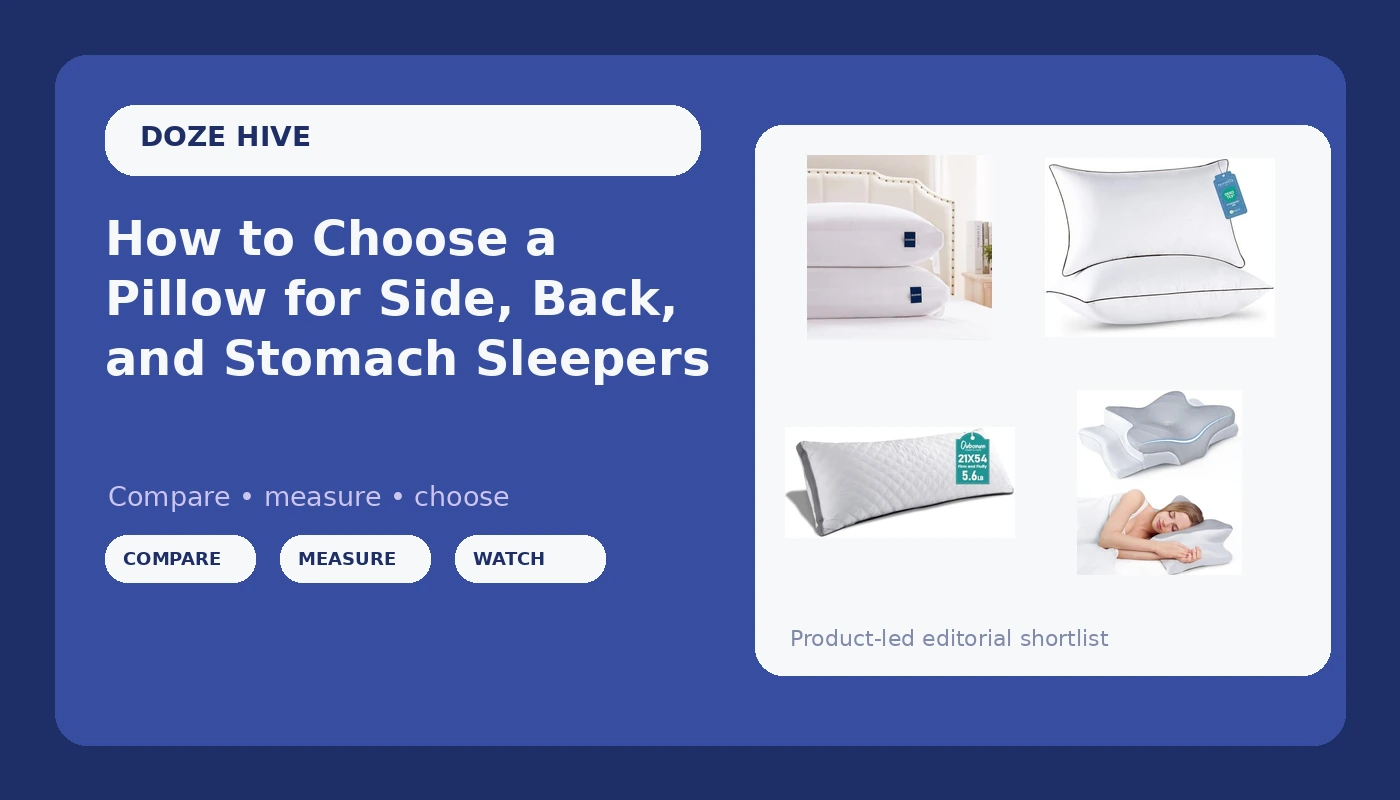
A pillow for side back stomach sleepers is really three purchases wearing one name. The loft that keeps a side sleeper's neck level with the spine will push a stomach sleeper's head up and tilt the airway; the low, flat profile a back sleeper wants leaves a side sleeper's shoulder jammed into the mattress and the neck bent sideways for eight hours. Add a warm sleeper who wakes at 2 a.m., a partner who likes a different height, and a budget that has to stretch across a guest room, and the pillow aisle stops being simple.
This is the part most listings skip. A product page can tell you the fill type, the size, the certifications, and which positions the maker had in mind. What it cannot tell you is whether the loft survives the night, whether the cover breathes, or whether the fill migrates into one corner by morning. So the useful job here is to sort the options below by the sleeper they actually fit, then walk through the checks that decide whether any pillow still looks like a pillow at month three.
Related: How to Wash Pillows Without Flattening the Fill →
Quick answer
Position decides first, fill decides second, and cooling claims come last. A standard-size set of two is the most flexible starting point because you can stack, fold, or swap loft between two people. A contoured cervical pillow is the shape to look at when neck support is the specific complaint. A full body pillow is the one to add when the problem is shoulder and hip alignment in the side position rather than the head alone. Among the four options here, the JOLLYVOGUE set covers the widest range of positions on paper with a certified down alternative fill, the ACCURATEX hybrid adds adjustable loft in a standard two-pack, the Ultra Pain Relief pillow is the contoured memory foam option, and the Oubonun is the long body pillow built for side sleepers.
Four useful options
| Model | Best fit | What stands out |
|---|---|---|
| JOLLYVOGUE Pillows Standard Size Set of 2 | Side, back, and stomach sleepers sharing one bed | Oeko-Tex certified down alternative fill, listed as cooling and firm, standard size two-pack |
| ACCURATEX Standard Pillows Set of 2 | Sleepers who want to change the loft without buying again | Adjustable hybrid construction in a standard-size two-pack |
| Ultra Pain Relief Cooling Pillow | Sleepers who want contour and cervical neck support | Adjustable cervical contour in memory foam, described as odorless, positioned for side, back, and stomach sleepers |
| Oubonun Full Body Pillow | Side sleepers who need support past the head | Full-length body pillow with adjustable firmness |
The everyday set: JOLLYVOGUE Pillows Standard Size Set of 2
The trade-off with any down alternative is loft retention. A fiber fill feels wonderful on night one and slowly compresses, and the only way to slow that down is to fluff it, rotate it, and keep it out of a too-small pillowcase that squeezes the fill into the corners. Down alternative also tends to be the easiest of the fills to wash, which matters if the pillow lives on a guest bed that gets used twice a year and needs to smell like nothing when it does. "Hotel collection" is a styling phrase, not a spec, so judge this set on the fill, the stitching, and how it recovers after a wash rather than on the word hotel.
The adjustable hybrid: ACCURATEX Standard Pillows Set of 2
The catch with adjustable pillows is that the word covers a lot of designs. Some have a zipper and loose fill you can scoop out, some use stacked layers, and some simply have a softer and a firmer side. Before buying, look for how the adjustment actually works and whether the fill is accessible. An adjustable pillow that cannot be re-filled is a fixed pillow with a marketing budget. The other thing to plan for is the two-night settling period: vacuum-sealed pillows arrive compressed, and judging the loft on the first evening is how people end up returning a pillow that would have been fine.
The contoured cervical option: Ultra Pain Relief Cooling Pillow
Foam is the fill that divides people. It gives a slow, even sink that fiber cannot copy, and it also runs warmer because it does not let air move through the way loose fill does. That is why a cooling claim on a foam pillow deserves more scrutiny than the same claim on a fiber one. "Cooling" on a memory foam pillow can mean a gel infusion, a phase-change cover, or simply a breathable knit cover over standard foam, and only the cover part touches your skin. If you sleep hot, plan on a breathable pillowcase and give any new foam pillow a few days in a ventilated room before it goes on the bed.
The full body option: Oubonun Full Body Pillow
A body pillow is not a replacement for a head pillow, and that is the most common mistake. It is an addition, and it takes up real estate. On a queen bed shared with a partner, a full-length pillow down the middle is a negotiation. The reward is that it holds the upper body in a neutral line, which is why side sleepers who wake with a stiff shoulder often notice a body pillow before they notice a new head pillow. If you have a CPAP mask, keep the tubing route in mind too, because a long pillow that sits against your chest can pull on the hose when you roll.
Prices and availability may change. Product images, names, and retailer links must be matched by verified ASIN. Do not state a current price, rating, stock status, or measured result without current evidence.
Why your sleep position decides the pillow
The job of a pillow is to keep the head, neck, and upper spine in a line that does not require the muscles to hold anything up. Each position changes what that line looks like.
A side sleeper creates a gap between the side of the head and the mattress that is roughly the width of one shoulder. Fill the gap short and the neck bends down toward the mattress all night. Fill it too tall and the neck bends up. This is the position that needs the most loft and the most resistance, because a soft pillow collapses under the weight of the head and leaves the gap half empty by 3 a.m.
A back sleeper needs the opposite. The head should rest slightly forward with the chin level, which means a moderate loft and a shape that supports the curve under the neck. Too tall and the chin tips toward the chest; too flat and the neck arches back.
A stomach sleeper needs the least height of the three. Sleeping face down with a tall pillow tilts the head back and rotates the neck, so a thin, soft pillow or a very low loft is usually the better match. Stomach sleepers who also turn onto their side during the night are the hardest to fit with one pillow, and they are the strongest argument for an adjustable design.
What "adjustable," "cooling," and "firm" actually mean on a listing
These three words do more work in pillow marketing than any others, and they mean less than they appear to.
Adjustable usually means one of three things: removable fill behind a zipper, layered inserts you can take out, or a pillow with two different heights on its two long edges. Only the first two let you change the pillow after you own it. Check which one you are buying, because a pillow that says adjustable but has no accessible fill is fixed.
Cooling is about airflow and contact. A cover can wick heat away from the surface of your skin, and a fill can either let air move through it or trap it. Gel-infused foam and open-cell foam are attempts to move heat through the foam itself. A "cooling cover" on a dense fill is a cool surface on a warm pillow, and it stops helping the moment you turn your face to a new spot.
Firm is the least standardized word of the three. There is no scale, no number, and no testing body behind it. The closest thing to a real measure is fill weight, which many listings do not publish. If a pillow is described as firm, treat that as a starting point and read the reviews sorted by most recent to see whether buyers describe it the same way six months in. Oeko-Tex certification, by contrast, is a real third-party standard, but it covers harmful substances in the textile, not support, height, or durability.
- Start with the position you actually wake up in, not the one you fall asleep in, since most people move at least once.
- Measure the gap between your neck and the mattress while lying on your side. That number is the loft you need, and it is usually taller than people guess.
- Decide whether you need adjustability. If two people share the bed, or you change positions during the night, it is worth paying for.
- Check the fill and the construction. Look for a stated fill type, a certification if the listing offers one, and a zipper if the pillow claims to be adjustable.
- Amortize the price over five years and compare that number to the cost of replacing a cheap pillow every eighteen months.
Shopping without getting burned
- Give a vacuum-sealed pillow a full 48 hours to plump before you judge the loft. It will look flat on day one, and that is normal.
- Air out a new foam pillow in a ventilated room for several days. Odor that lingers past a week is a reason to send it back, not a reason to keep waiting.
- Buy a pillow protector on day one. It keeps the fill clean and makes the wash cycle far less risky for the casing and stitching.
- Fluff and rotate fiber pillows weekly, and check the loft at month three. That is when a fill that is going to flatten starts to show it.
- Shop for each sleeper separately. A set of two only helps if both pillows are right for the people using them.
Which option should you choose?
Choose the JOLLYVOGUE Pillows Standard Size Set of 2 when you want one standard-size pair to cover a shared bed and a range of positions, with a certified down alternative fill that is straightforward to wash. Choose the ACCURATEX Standard Pillows Set of 2 when the two sleepers in the house want different heights and you would rather adjust the loft than shop again. Choose the Ultra Pain Relief Cooling Pillow when neck support and a contoured shape are the priority and you want foam with an adjustable cervical section. Choose the Oubonun Full Body Pillow when you sleep on your side and the stiffness is in your shoulder or hip rather than your neck.
One caveat worth stating plainly: a pillow can support a comfortable position, and it cannot diagnose or treat a medical condition. If you use a CPAP, the mask fit and hose routing matter as much as the pillow, and a change in neck pain that does not settle in a couple of weeks is a conversation for a clinician, not a product page.
The bottom line
Match the loft to your position before you read a single review, then choose the fill that suits your temperature and your laundry habits. For most households, that means a standard two-pack as the baseline, an adjustable design where two sleepers disagree, a contoured foam pillow where neck support is the specific complaint, and a long body pillow where the shoulder and hip line is the real problem. Judge every one of them on how the loft holds at month three, because that is the night the cheap pillow reveals itself.