Most pillows are sold on three words: hotel quality. That phrase tells you nothing about whether a pillow will still hold its loft at 3 a.m., which is the only test that matters. I have bought, slept on, and returned enough queen pillows for side sleepers to know that the words on the bag are the last thing worth reading.
I sleep on my back. My husband Tom has slept on his side for forty years and can judge the loft and the weight of a pillow the first night. The guest room gets stomach sleepers, back sleepers, and one nephew who sleeps like he fell out of an airplane. So every pillow that comes into this house gets slept on in all three positions before it earns a spot on a bed, and the ones that fail go back in the box.
What follows is the fitting process I use, in order, plus the two sets currently on the beds in my house.
Why you should trust me
I am not a sleep scientist. I am a retired middle school teacher in Austin who spent the better part of 15 years chasing the perfect pillow and has the return receipts to prove it.
For more than 20 years I slept on a Tempurpedic foam pillow and loved it. Nothing beat that first sink. But every replacement I ordered came back too hard, too soft, or too expensive, and I returned every single one of them. Tom and I also spent $300 each on pure down pillows years ago and adored them, which is exactly why retirement forced me to get serious about this. I started testing instead of guessing: a down alternative I bought on an influencer's whim (I hate to admit that part), buckwheat that sounded like a bag of cereal the first night, a hotel set bought for the guest room that ended up on my own bed.
I take sleep seriously. There is a CPAP machine on my nightstand, blackout blinds on the windows, an air filter running as white noise, and an adjustable bed under all of it. Because Tom is a lifelong side sleeper, I am a back sleeper, and the guest bed gets stomach sleepers, I test every pillow in all three positions and keep a night-by-night log of neck pain, tossing and turning, and overheating at 2 a.m.
I will tell you what supported my neck. I will not diagnose yours.
How I picked and how I tested
Right now I am running 8 pillows through a 30-night rotation, and the two sets below are the ones that survived long enough to stay in the house.
The rules I test by:
- Two weeks of real nights minimum, in side, back, and stomach positions, logged the next morning instead of remembered.
- No cooling claim without a warm-sleeper check. I sleep warm, so I am the test.
- No firmness claim without checking fill weight and pressing the pillow myself. "Firm" has burned me before.
- No "hotel quality" claim until I have looked at the stitching, felt the casing, and washed it.
The log itself is simple. Neck pain scored 1 to 10 in the morning, how many times I woke up, and whether I was hot at 2 a.m. A pillow that scores well on night three and badly on night twelve is a pillow that goes flat, and that is the failure mode I care about most.
Then there is the money. A pillow is a five-year purchase, not a $30 impulse. Divide the price by five and the expensive pillow becomes the cheap one. That math is why I stopped buying $5 pillows that are flat by week two.
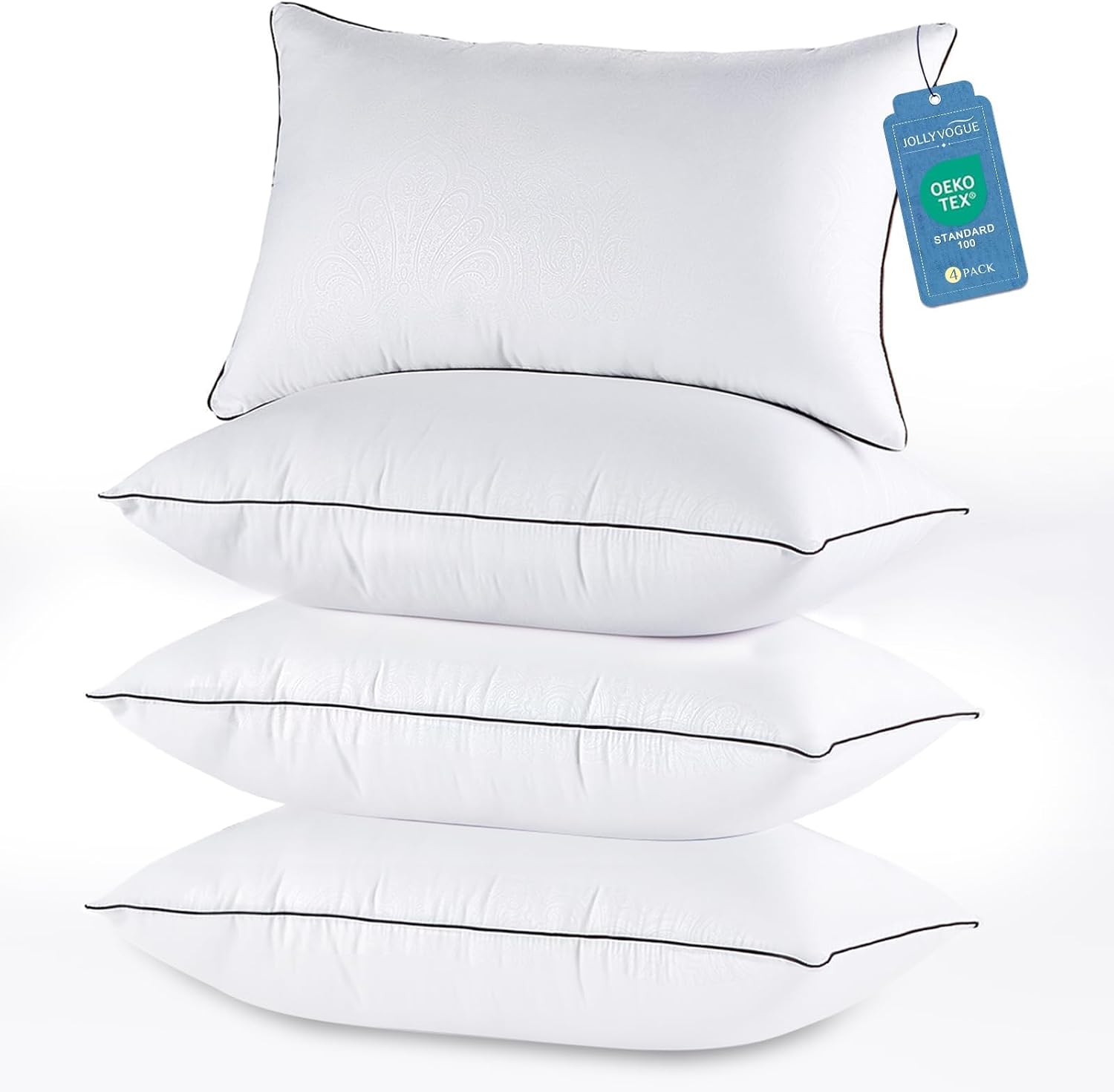
The four-pillow value pick: JOLLYVOGUE Pillows Queen Size Set of 4, Cooling and Firm Pillows with Oeko-Tex Certified Down Alternative Filling for Side, Back, and Stomach Sleepers, Hotel Collection
 Visit on Amazon →
Four pillows in one box is the reason this set is the one I recommend first. A queen bed with two sleepers needs four pillows if you want one under your head and one to hug or prop behind you, and buying them four at a time is how you stop rotating the same two flat pillows for a decade.
The fill is a down alternative with Oeko-Tex certification, which matters to me because the chemical odor on a vacuum-sealed foam pillow is a dealbreaker no matter how good the reviews are. This one aired out clean. The firmness sits in the middle-to-firm range, and I could feel the fill through the casing, which is my first check. A pillow that feels half empty on day one is half empty on day 300.
In the side position, it filled the gap between Tom's shoulder and his ear without going flat by morning, and he is the hardest person in this house to please. On my back, it kept my neck level instead of tipping my chin up. In the stomach position I had to pull it down thinner, which is normal for a pillow this lofty.
Cooling is the most lied-about claim in bedding, so here is the honest version. The cover sleeps cooler than a standard cotton pillowcase on a foam pillow, and the fill did not cook me at 2 a.m. in an Austin summer with the ceiling fan on. It is not a refrigerated pillow. Nothing is.
Flaws but not dealbreakers: Four pillows take up closet space if you are not using them all, and the loft is generous enough that a strict stomach sleeper will want to compress it or use it as the second pillow instead of the first. It arrives vacuum sealed and looks skeptical on day one, so give it the full two days.
Anyone setting up a queen bed for two sleepers, or a guest room that has to serve all three positions, gets the most out of this set.
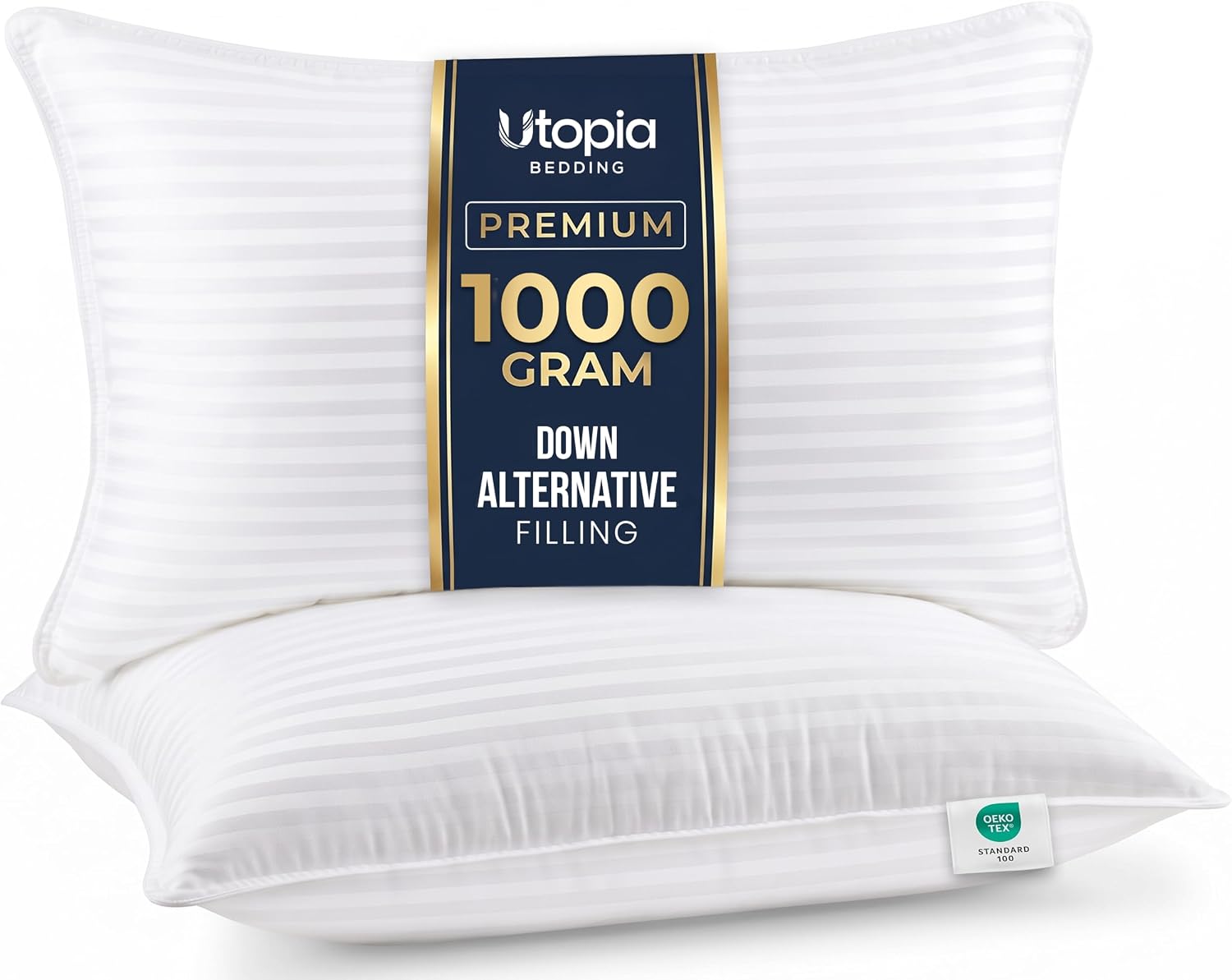
The starter pick: Utopia Bedding Hotel Bed Pillows for Sleeping, Pillows Queen Size Set of 2
 Visit on Amazon →
This is the set I hand to someone who has never thought about pillows and just wants the bed to feel like a hotel bed. Two pillows, queen size, medium loft, and a casing that stays smooth after a wash. The stitching held up, and I checked, because "hotel quality" is a marketing phrase until the stitching, fill, and casing survive a real wash.
It is not as firm as the four-pillow set above. If you are a side sleeper who needs real height, this one alone will leave your neck angled down toward the mattress by morning. Where it shines is the back position and the guest bed. It has enough loft to support a back sleeper's neck curve, it sleeps cool enough, and it does not have that chemical smell out of the bag.
Two pillows for a guest room is also the right number. Guests who need more height can double them up, and you are not storing four pillows for a room that gets used twice a year.
Flaws but not dealbreakers: Medium loft means medium support. Side sleepers should treat this as a base pillow and add loft, or buy the firmer set. It also arrives vacuum sealed and flat, so let it breathe.
Anyone furnishing a guest room, or a back sleeper who wants a soft hotel-style pillow without paying hotel prices, will be happy here.
The actual fitting workflow
Now the part you came for. None of this needs a meter or a spreadsheet, though I keep one anyway.
Step one: sleep position first, pillow second. Lie down without a pillow. Side sleepers have a gap between the ear and the mattress that runs from the shoulder to the jaw. Back sleepers need the neck curve filled with the chin level. Stomach sleepers need almost nothing, or they wake up with a twisted neck. Your position decides your loft before any product page does.
Step two: measure the gap with your hand. On your side, slide your hand under your head and against the mattress. One hand thickness is a low pillow. Two hands is medium. Three is a tall, firm pillow. That number is your target, and it does not change because a listing says "firm."
Step three: check the fill before you commit. Press the center of the pillow with your palm. Good fill pushes back evenly and you feel it through the casing. If your hand sinks to the mattress with no resistance, the pillow is underfilled, and it will go flat.
Step four: give it two days. Vacuum-sealed pillows need to plump. I have zero patience and have slept on the flat version on night one anyway, and I can tell you it is not the pillow you bought. Two days on the bed, fluffed twice a day.
Step five: run the 2 a.m. cooling check. If you wake up hot at 2 a.m. and your pillow is the warm spot, the cover is marketing and the fill is the problem. Give it a week before you decide. One hot night is weather. Five hot nights is the pillow.
Step six: wash it once. A pillow that cannot survive a wash is a pillow you will replace for reasons that have nothing to do with support. Follow the care tag, dry it fully, and check whether the fill clumped.
Step seven: check the loft at month three. This is the step almost nobody does. Measure the height at the center, then measure it again at month three and month twelve. A pillow that loses half its height in three months was never a five-year purchase, no matter what it cost.
Step eight: rotate. Two pillows per sleeper, rotated weekly, doubles the life of both. It sounds fussy. It is also the cheapest upgrade in this article.
The competition and why it lost
The Beckham Hotel Collection is the best reasonably priced down alternative I have tested. Soft casing, no chemical odor, and the filling and stitching are perfect. It started in the guest room and ended up on our bed, and it is a fair alternative to either set above if the ones here do not fit your position.
Buckwheat is another level of support altogether. The heft tells you it is actually full, it holds its shape all night, and it does not sleep hot. It is also noisy, it sounds like a bag of cereal the first night, and the hulls compress over five years. I keep one on my own bed. I do not put one in the guest room, because the crunching is not for everyone.
Coop Home Goods is the adjustable pillow that actually holds its fill, and I have cut open cheaper "adjustable" pillows that were half empty by month six.
The $300 pure down pillow is still the gold standard I measure everything against. Heavy, plush, cloud-like, and the reason I now amortize every pillow purchase over its lifespan instead of flinching at the register.
And the $5 pillows are the reason people think they hate pillows. Flat by week two. I am kind of tired of them.
What this all costs
Do the math on whatever you pay, because the math is the easy part. A pillow that lasts five years costs one-fifth of its price per year. A pillow that goes flat in eight months costs its full price every eight months, forever.
Two pillows per sleeper is the real number, not one. Rotate them and both last longer. A guest room needs two, not four. And a four-pillow set for a queen bed is not extravagance, it is the correct count for two people.
The rest of the list is free. The two-day plumping rule costs nothing but patience. The 2 a.m. cooling check costs one week of sleep. The loft measurement at month three costs one minute with a ruler, and it is the single best predictor of whether you will be buying pillows again next year.
Check current Amazon price on both sets, do the hand measurement on your own mattress first, and buy the loft your sleep position actually asks for. That is the whole job. Your neck does the rest.