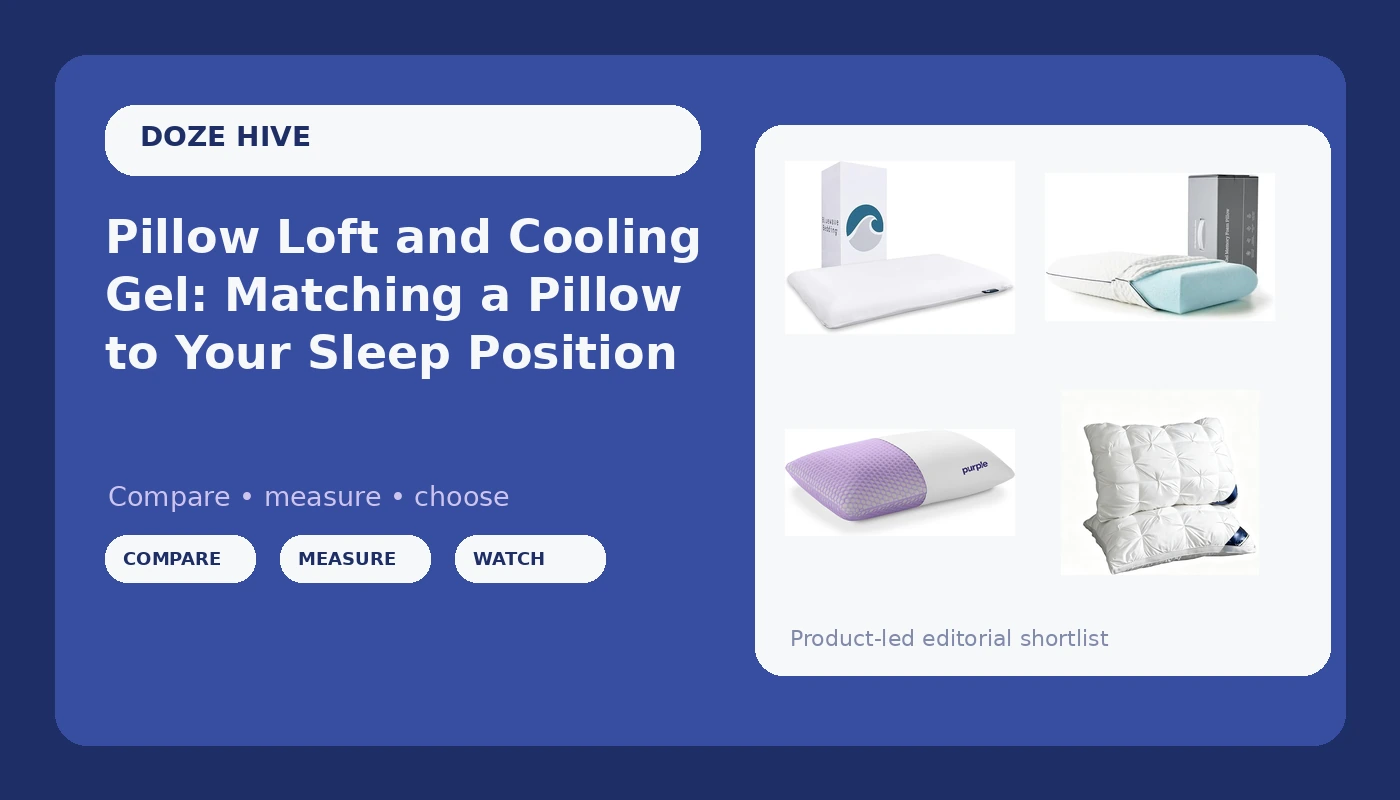
A pillow is the piece of sleep gear you replace most often and think about least, and it is also the one most likely to show up flat. Most pillows sold online arrive vacuum sealed, looking like a folded towel, and the first night tells you almost nothing about how the thing will behave in month three. What actually decides whether a pillow works is loft, fill, and how warm it sleeps, and those three things have to match the position you wake up in rather than the one you fall asleep in. Choosing a pillow by sleep position is less glamorous than shopping by brand or by whatever the package calls "firm," but it is the only method that has ever survived a real night. This guide walks through four pillows at four different heights and price points, explains what each one is built for, and shows how to tell a genuine cooling feature from a word printed on a tag.
Related: How to Pick a Pillow Loft for Side Sleepers →
Quick answer
Match loft to position first, then worry about fill and cooling. Stomach sleepers need the least height, back sleepers need a little more, and side sleepers need enough loft to fill the gap between the head and the shoulder. Of the four pillows here, the Bluewave Bedding Ultra Slim is the thinnest at a stated 2.75-inch height, the Weekender and the Purple Harmony sit in the medium range, and the Bed Pillows Queen Size set is the two-pillow option for guest rooms and stacking. None of them is universally better than the others; they are built for different bodies, different beds, and different budgets.
Four useful options
| Model | Best fit | What stands out |
|---|---|---|
| Bluewave Bedding Ultra Slim Gel Memory Foam Pillow | Stomach and back sleepers who need a thin profile | Stated 2.75-inch height, gel memory foam, standard size |
| Weekender Cooling Gel Memory Foam Pillow | Side and back sleepers who sleep warm | Ventilated gel memory foam, queen size, medium firm, washable cover |
| Purple Harmony Pillow | Side and back sleepers who want a medium loft with a cooling gel layer | Medium loft, standard size, cooling gel neck pillow design |
| Bed Pillows Queen Size Set of 2 | Guest rooms and anyone who wants two low-commitment pillows | Two queen pillows, 20 by 30 inches, washable |
The thin-profile pick: Bluewave Bedding Ultra Slim
The 2.75-inch number is the entire story here. That is roughly a third of the height a dedicated side-sleeper pillow runs, which is exactly why it suits people who sleep on their stomach or flat on their back and exactly why it will frustrate someone who needs to fill a shoulder gap. The trade-off is honest: buy it for its thinness, not in spite of it. Gel memory foam also holds more heat than a loose fill, so if you sleep warm, the low profile helps a little but does not make it a cooling pillow. Give any vacuum-sealed foam a couple of days to plump before you judge the height.
The warm-sleeper pick: Weekender Cooling Gel Memory Foam Pillow
Ventilation is the detail worth noticing, because airflow through the foam is the part a "cooling" label usually leaves out. A gel layer on the surface can feel cool for the first twenty minutes; a ventilated structure is what keeps the fill from turning into a warm brick at 2 a.m. The other trade-off is size. A queen pillow is a real footprint on a queen bed, and if two people share the mattress, two queen pillows take up more room than two standard ones. The washable cover matters more than it sounds, because a cover you can actually remove and launder is what keeps a foam pillow from becoming a permanent dust trap.
The premium cooling-gel pick: Purple Harmony Pillow
Medium loft sits in the sweet spot between the flat Bluewave and a tall, overstuffed side-sleeper pillow, which is why it works for back-and-side switchers. The cooling gel layer is a surface feature, not a guarantee about the whole pillow, so read it as a top layer rather than a promise about the fill. The real trade-off is money. This is the kind of purchase where amortizing the cost matters: divide the price by five years of nights and a premium pillow stops looking extravagant, provided it actually holds its loft that long. That is the assumption to check, not the sticker.
The guest-room set: Bed Pillows Queen Size Set of 2
A set like this is a generalist, and generalists come with a trade-off. The listing does not promise a specific loft, so it is not the pillow to buy if you need a precise height for a specific sleep position. What it is good at is the job most people actually need done: keeping a guest bed made up, being easy to wash after a visitor leaves, and giving you two pillows to experiment with before you spend real money on a specialty shape. If a guest complains about height, a second pillow from the same set is the cheapest fix there is.
Prices and availability may change. Product images, names, and retailer links are matched to verified listings. No current price, rating, stock status, or measured result is stated here without current evidence.
Loft and sleep position: the three-position reality
Loft is the height of the pillow once your head is on it, and it is the single number that decides whether your neck is straight or bent. Stomach sleepers generally need the least loft, because the body is already flat and a thick pillow tilts the head back. Back sleepers need a little more, enough to support the natural curve of the neck without lifting the chin. Side sleepers need the most, because the pillow has to fill the space between the side of the head and the mattress while the shoulder pushes the mattress down.
That space is the shoulder gap, and you can measure it at home. Lie on your side on your own mattress, let your head settle into a neutral position, and have someone photograph you from the front. If your nose points down toward the mattress, the pillow is too low. If your chin lifts and your neck bends upward, it is too high. A pillow that only works in one of those three positions should be described that way, which is why the Bluewave listing says stomach and back sleepers rather than simply "sleepers." Buying a single pillow for a household with a side sleeper, a back sleeper, and a stomach sleeper is how guest rooms end up with three rejected pillows in the closet.
What "cooling" actually means on a pillow label
Cooling is the most elastic word in bedding. It can mean a gel layer bonded to the top of a foam pillow, a ventilated foam structure with channels that let air move through, a phase-change fabric on the cover, or nothing more than a smooth, slightly slick cover that feels cool when you first lie down. Those are four different things, and only some of them do anything at 2 a.m., when your body heat has had hours to build up in the fill.
The practical way to read a cooling claim is to ask where the cooling lives. A gel layer is a surface feature: pleasant on contact, limited once the pillow warms. A ventilated design is a structural feature: it addresses airflow through the foam, which is the part that actually keeps a pillow from cooking you. A cover is a cover, and covers can be swapped. If a listing mentions only a "cooling cover" and says nothing about the fill, treat the claim as a fabric description rather than a temperature promise.
- Start with the position you wake up in, not the one you fall asleep in. That is the position your neck spends the most hours in.
- Measure your shoulder gap on your own mattress, since mattress firmness changes how far your shoulder sinks.
- Set a loft ceiling before you shop: thin for stomach sleeping, medium for back and combination sleeping, taller for dedicated side sleeping.
- Decide where the cooling claim lives: gel layer, ventilated structure, or cover only. Rank them in that order for a warm sleeper.
- Amortize the price over five years, then compare the yearly number instead of the sticker.
Practical guidance for buying and keeping a pillow
- Let a vacuum-sealed pillow plump for a full two days before you judge it. Foam and fiber both need time to recover their shape, and judging on night one is how good pillows get returned.
- Press-test any firmness claim with your own hand. "Medium firm" on a listing and "medium firm" under your head are two different measurements, and only one of them is yours.
- Check the cover before the fill. Stitching, a removable zipper, and a casing that survives a wash tell you more about how a pillow will age than any adjective on the package.
- Keep the guest room simple. A washable two-pillow set plus one specialty pillow in a different loft covers almost every visitor without turning the closet into a pillow graveyard.
- Rotate and wash on a schedule, and check the loft at month three. If the pillow has already flattened by then, it will not make it to year five, and the cost-per-year math changes completely.
Which option should you choose?
Choose the Bluewave Bedding Ultra Slim Gel Memory Foam Pillow when you sleep on your stomach or flat on your back and you want the thinnest profile in this group. Choose the Weekender Cooling Gel Memory Foam Pillow when you sleep on your side or back, you sleep warm, and you want a ventilated queen-size pillow with a washable cover. Choose the Purple Harmony Pillow when you want a medium loft with a cooling gel layer for neck support and you are willing to pay more upfront for it. Choose the Bed Pillows Queen Size Set of 2 when you are outfitting a guest room, a rental, or a first apartment and you want two washable queen pillows without committing to a specialty shape.
One caveat applies to all four: height, firmness, and warmth are personal, and a listing can only describe what is inside the pillow. It cannot tell you how your neck responds. Buy from a seller with a return window you understand, keep the packaging for the first two weeks, and give the pillow the full plumping period before you decide.
The bottom line
Sleep position decides loft, loft decides comfort, and comfort is what stops the tossing and turning. A thin gel memory foam pillow is the right answer for stomach and back sleepers, a ventilated medium-firm pillow covers side and back sleepers who run warm, a medium-loft cooling gel pillow is the premium middle ground for people who switch positions, and a two-pillow washable queen set handles the guest room without any drama. Match the pillow to the position, check where the cooling claim actually lives, and divide the price by the years you expect to keep it. That is the whole method, and it works whether the pillow costs a little or a lot.