Most people buy a pillow the way they buy a phone case: quickly, cheaply, and without checking whether it fits. Then they spend two years waking up with a stiff neck and blaming the mattress. Pillows for side and back sleepers are doing two different jobs, and a stomach sleeper needs a third thing entirely. Get the loft, the fill, and the shape right and you stop rearranging your head at 2 a.m. Get them wrong and no thread count rescues you.
This is an explainer, not a ranking. It walks through what each type of pillow is actually for, four specific options with the details that matter, and a way to choose that does not depend on whoever paid for the loudest review.
Related: Pillow Fill Types Compared: Down, Memory Foam, and Buckwheat →
Quick answer
Match the pillow to the sleep position first, then to the fill, and only then to the price. Side sleepers need enough loft to fill the gap between the ear and the outer shoulder. Back sleepers need a lower profile that keeps the chin level instead of tipping it toward the chest. Stomach sleepers need the thinnest pillow in the house, sometimes no pillow at all. A contoured memory foam pillow is built for back and side positions, a feather and down set suits anyone who wants a traditional squashable pillow, a full body pillow supports the hips and knees as much as the head, and a reusable gel wrap is an add-on for a warm sleeper rather than a pillow in its own right.
Four useful options
| Model | Best fit | What stands out |
|---|---|---|
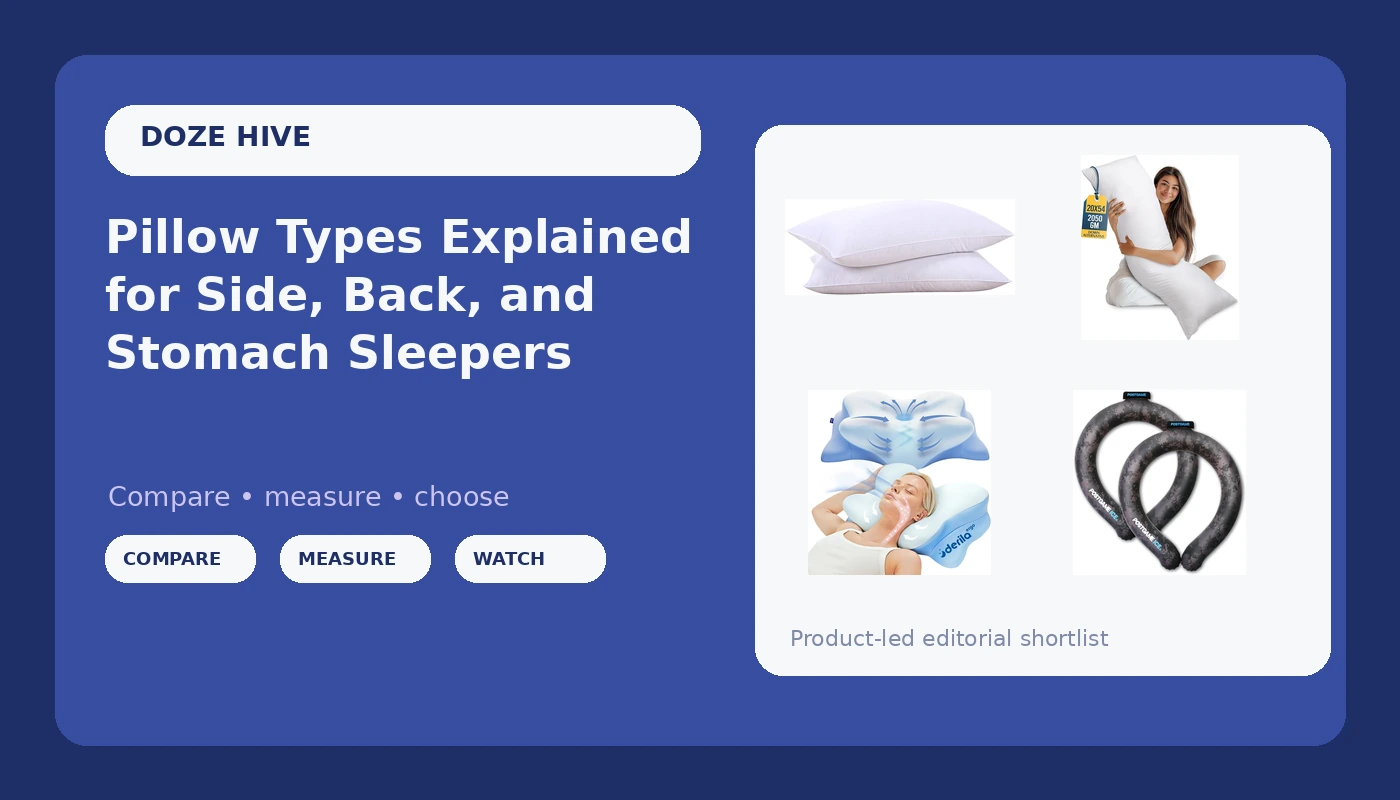
| Derila Ergo Cervical Neck Pillow for Sleeping Pillow Contour Memory Foam Pillows for Back, Side Sleeper Pillows 21.25 x 14.17 x 4.72 inches | Back and side sleepers who want contoured neck support | Contour memory foam shape, listed at 21.25 x 14.17 x 4.72 inches |
| puredown® Goose Feathers and Down White Pillows with 100% Cotton Cover, Bed Sleeping Hotel Collection Pillows Set of 2, Standard Size | Sleepers who want a traditional down feel in a two-pillow set | Goose feather and down fill with a 100% cotton cover, standard size, set of 2 |
| Utopia Bedding Full Body Pillow for Side Sleeper, White Long Pillow for Bed | Side sleepers who want support beyond the head | Long full body shape made for side sleepers |
| rituo Postgame Cooling Neck Wrap, Reusable Gel Ice Pack, L/XL (Pack of 2) | Warm sleepers who want a cold pack that stays where they put it | Reusable gel ice pack, L/XL, pack of 2 |
Neck support pick: Derila Ergo Cervical Neck Pillow for Sleeping Pillow Contour Memory Foam Pillows for Back, Side Sleeper Pillows 21.25 x 14.17 x 4.72 inches
The point of a contoured pillow is that the shape, not the fill, does the supporting. A flat pillow has one loft and you take whatever your shoulder leaves you; a contoured one has a dip for the back of the head and a raised section that sits under the curve of the neck. That is why the dimensions matter more here than in most listings: 21.25 x 14.17 x 4.72 inches tells you the footprint and the height you are working with before anything compresses.
Two trade-offs come with memory foam. First, it responds to body heat, which is part of how it molds and also part of why warm sleepers notice it. Second, new foam can carry an odor out of the packaging, so give it air before the first night. If you sleep mostly on your stomach, a shaped contour pillow is usually the wrong tool, because the raised section pushes the chin up rather than letting the head lie flat.
Traditional down set: puredown® Goose Feathers and Down White Pillows with 100% Cotton Cover, Bed Sleeping Hotel Collection Pillows Set of 2, Standard Size
Feather and down is the oldest pillow technology there is, and it behaves differently from foam in one important way: you can reshape it every night. Fold it in half for a higher loft, punch it down for a flatter one, push the fill away from the center if you want a hollow for your ear. Nothing else in bedding is that adjustable without zippers.
What it will not do is hold a shape on its own. Down compresses under the head, so a side sleeper with broad shoulders may need two pillows stacked or a firmer fill underneath. Feather content adds support and a little rustle; down content adds softness. The 100% cotton cover is the breathable part, which is why down sets tend to sleep cooler than foam in the same room. Read the care label before you wash anything, because how a pillow survives a wash depends on the fill and the stitching, not on the words "hotel collection" printed on the bag.
Side sleeper support: Utopia Bedding Full Body Pillow for Side Sleeper, White Long Pillow for Bed
A body pillow solves a problem a head pillow cannot reach. When you lie on your side, the top leg drops forward and rotates the lower spine unless something holds it in line. Tucking a long pillow between the knees and against the chest keeps the hips stacked. Side sleepers who wake up with a sore lower back often blame the mattress when the real issue is a leg that has been drifting for six hours.
The trade-off is footprint. A full body pillow takes up a real share of a queen bed, and it needs its own long pillowcase, which is a separate purchase most people forget. It also does not replace a head pillow; it works alongside one. If you share a bed with someone who sprawls, measure before you commit.
Warm sleeper add-on: rituo Postgame Cooling Neck Wrap, Reusable Gel Ice Pack, L/XL (Pack of 2)
This is not a pillow, and it is worth being clear about that. It is a cold pack that wraps the neck, which makes it useful for the specific problem of a hot head and neck at 2 a.m. when a pillow cover has already failed to help. A pack of two matters more than it sounds: one stays in the freezer while the other is in use, so you are not lying awake waiting for a gel pack to re-chill.
Use it as a supplement, not a substitute. Cold on the neck before bed can feel good after a long day, and a cool wrap can take the edge off a warm room, but it does not fix loft, and it does not support a side sleeper's shoulder. If your pillow is the reason you are waking up, a gel wrap will not solve that.
Prices and availability may change. Product images, names, and retailer links must be matched by verified ASIN. Do not state a current price, rating, stock status, or measured result without current evidence.
Loft, fill, and why sleep position decides everything
Loft is the height of the pillow once your head is on it, and it is the number that actually matters. Side sleepers need the most loft because the shoulder creates a gap between the mattress and the ear; if the pillow is too low, the neck bends downward all night. Back sleepers need less, enough to keep the head neutral without pushing the chin toward the chest. Stomach sleepers need the least, because a thick pillow rotates the head and strains the neck.
Fill determines how the loft behaves. Memory foam holds its height and responds to heat, so it feels firmer in a cold room and softer after twenty minutes. Feather and down start high and compress, which is why you fluff them. Polyester fiberfill sits in the middle and tends to flatten fastest over time. Buckwheat hulls do not compress at all, which is why they feel so solid and sound so loud.
The practical test is simple. Lie down in your usual position, and have someone look at your head and neck from the side. Your nose should line up roughly with the center of your chest, and your chin should be level, not tucked and not tipped up. If you have to stack an arm under the pillow to get comfortable, the loft is wrong, and no amount of breaking in will fix it.
Why cooling claims deserve scrutiny
"Cooling" is the most abused word in bedding. A cooling cover is a fabric on the outside. The fill on the inside is what holds heat, and foam holds more of it than down or hulls. A pillow can have a genuinely breathable cover and still run warm by 2 a.m. because the material under your head is insulating you.
That is why the honest way to evaluate a cooling claim is to separate the two parts. Ask what the cover is made of, then ask what is inside. Cotton covers breathe better than tightly woven synthetics. Gel-infused foam is still foam. Perforated foam is still foam. None of that makes a pillow bad; it just means the marketing word and the actual experience are two different things.
If you sleep warm, treat cooling as a system rather than a purchase. A breathable cover, a cooler room, and a cold pack you can rotate in the middle of the night will do more than any single "cooling" pillow. And if a listing promises a temperature drop, be skeptical of the number until you have slept on it yourself.
- Sleep in your dominant position for two weeks before you decide anything. One night tells you nothing.
- Log the mornings, not the nights. Neck score, how many times you woke, whether you were hot at 2 a.m.
- Test the loft with your own shoulder, not the product photo. Side sleepers need more than the listing suggests.
- Check the fill and the casing separately before you believe a cooling claim.
- Divide the price by the years you expect to keep it, then compare that number instead of the sticker.
Keeping a pillow working past year one
- Fluff a down or feather pillow every morning. Compressed fill that never gets shaken stays compressed.
- Give a vacuum-sealed pillow a full 48 hours to plump before you judge its loft.
- Air out new foam somewhere ventilated before the first night if it arrives with an odor.
- Wash according to the care label, and dry thoroughly. Damp fill is how a pillow starts to smell.
- Replace on a schedule rather than on a feeling. Most pillows are done well before they look done.
Which option should you choose?
Choose the Derila Ergo Cervical Neck Pillow when you sleep mainly on your back or side and want a shaped, contoured surface under the neck rather than a flat one. Choose the puredown® Goose Feathers and Down Pillows when you want the traditional squashable feel and the ability to reshape the pillow every night, and you are fine with fluffing it daily. Choose the Utopia Bedding Full Body Pillow when you are a side sleeper whose hips and lower back complain more than your neck does. Choose the rituo Postgame Cooling Neck Wrap when you run warm and want a cold pack you can rotate through the night, understanding that it is an add-on and not a pillow.
The caveat is that none of this is personal to you yet. The specs above are stated product details, not measured results, and firmness and warmth are the two things nobody can judge for you from a listing. Sleep position is the only variable you can settle in advance, so start there.
The bottom line
The pillow that works is the one whose loft matches your sleep position and whose fill you can live with for eight hours a night. Contour memory foam gives back and side sleepers a shaped surface, feather and down gives traditionalists something they can reshape at will, a full body pillow fixes a problem the head pillow never touches, and a gel wrap is the practical answer for a warm sleeper who has already tried a breathable cover. Get the position right first, then amortize the price over the years you will actually keep the thing, because a pillow is a five-year purchase, not a thirty-dollar impulse.