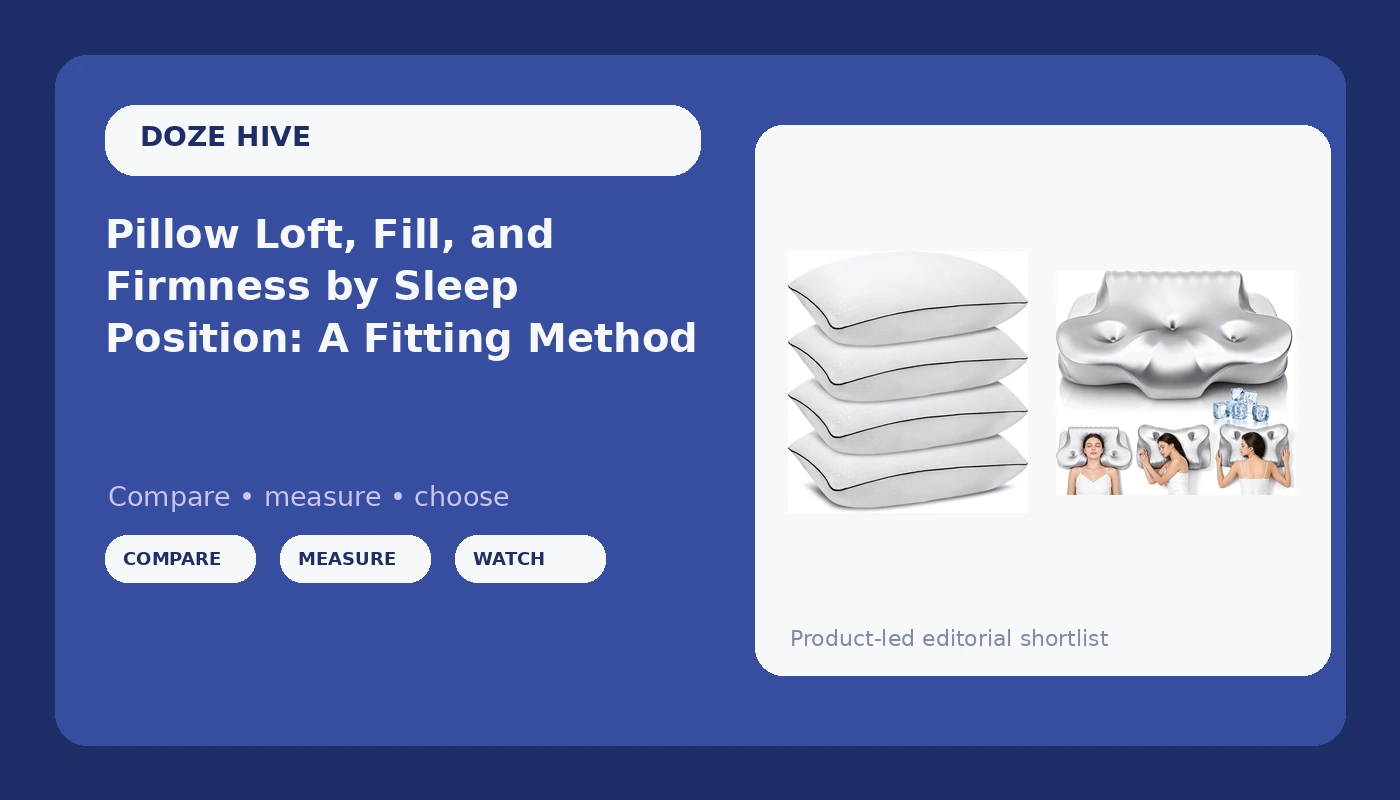
Most pillows are sold on one word. Firm. Plush. Hotel. None of those words tells you whether the thing will still be under your neck at 3 a.m., and after fifteen years of chasing the best pillow for sleep position and returning more Amazon orders than I care to admit, I can tell you the label is the least useful part of the listing.
I am a back sleeper. My husband Tom has slept on his side since before we met. The guest bed gets stomach sleepers, which means it gets a completely different pillow than ours. That is three separate problems, and no single "comfortable and supportive" promise solves all three of them at once.
So here is the process I use now, before I spend anything: match the pillow to the position first, give it time to plump, then check the loft again at month three and month twelve. The two pillows below are the ones I would start with this year, and I have said plainly where each one gives up.
Why you should trust me
I taught middle school for decades, which means I am constitutionally incapable of letting a claim slide without checking it. I slept on a Tempurpedic foam pillow for more than twenty years and loved that initial sink, then watched every replacement I ordered come back too hard, too soft, or too expensive. I returned all of them. Tom and I also spent real money on pure down pillows years ago and adored them, which is exactly why retirement made me start amortizing every bedding purchase instead of buying on impulse.
My bedroom is set up for sleep: a CPAP machine, blackout blinds, an air filter that doubles as white noise, and an adjustable bed. I keep a night-by-night log of neck pain, tossing and turning, and whether I woke up overheated at 2 a.m. I test every pillow in side, back, and stomach positions, because one bed in this house serves all three. I am not a doctor and I will not diagnose your neck. I will tell you what supported mine.
How I picked and how I tested
Two weeks minimum, in all three positions, logged in the morning instead of remembered at the end of the month. That is the floor. A pillow that only works when I am on my back gets written up as a back sleeper's pillow, not a universal one.
The four checks I run on every pillow:
Fill and press. I press the casing with a flat palm and feel for whether the fill pushes back evenly or collapses into a hollow. Firmness claims mean nothing until I have done this, because "firm" Amazon recommendations have arrived very soft and thin more than once.
Loft through the night. I note where my head sits at bedtime and where it sits at 3 a.m. Fill that migrates to one corner leaves a flat spot under your neck by morning, and that is the number one reason a pillow fails.
The 2 a.m. cooling check. I sleep warm, so I am the test. A cooling cover on a fill that cooks you is the most lied-about claim in bedding.
The wash check. "Hotel quality" is a marketing phrase until the stitching, casing, and fill survive a real wash cycle and a real dry.
Then I amortize. A pillow is a five-year purchase, not a monthly impulse, and dividing the price by the years it lasts changes the entire budget argument.
The two pillows I would start with
Both of these are mainstream, easy to replace, and forgiving of a household where the sleeper changes. They solve different problems, so read the role before the name.
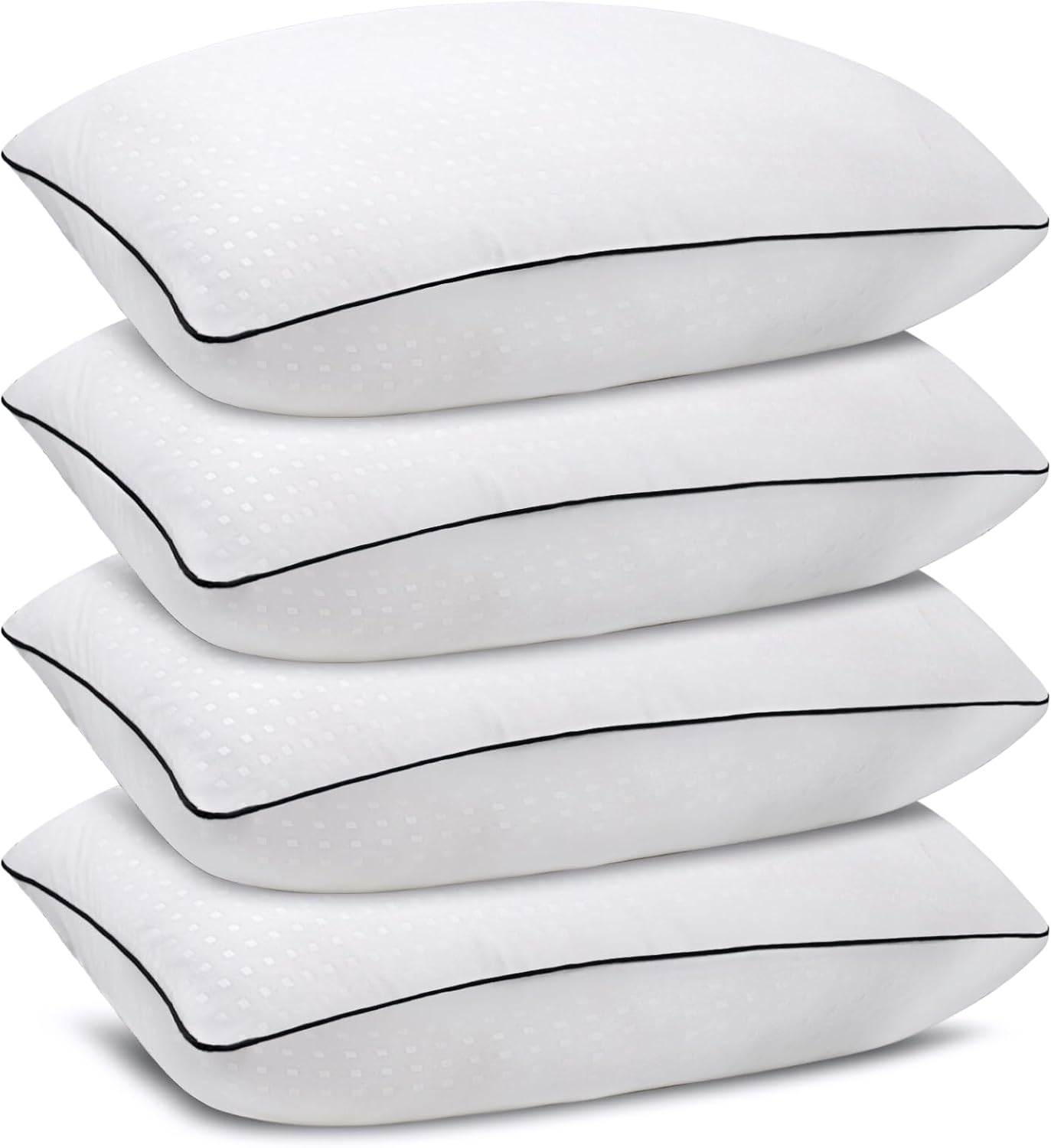
Budget pick: Standard Size Bed Pillows for Sleeping 4 Pack,Luxury Hotel Pillows,Comfortable and Supportive,Machine Washable,Suitable for Stomach,Back and Side Sleepers.
 Visit on Amazon →
This is a four-pack of standard size pillows, machine washable, marketed for stomach, back, and side sleepers. The four-pack is the real feature. It means a guest room can be outfitted in one order, and it means you can stack two pillows if the loft turns out to be lower than you wanted, which is the honest way to handle a pillow that claims to suit every position.
That claim is also the thing to be skeptical about. A pillow that promises all three positions is usually adequate in all three and perfect in none. For stomach sleepers, a low loft is exactly right, so this set is a genuinely good match. Back sleepers will likely be fine. Side sleepers with broad shoulders may find themselves folding the pillow or adding a second one to fill the shoulder gap, and that is a real limitation, not a dealbreaker.
Because these are machine washable, run the wash check before you commit the set to the guest room. Look at the seams after the first cycle. Look at whether the fill stays distributed or clumps to one end. And treat "luxury hotel" as a description of the look, not a guarantee about the fill weight, because that phrase has burned me on pillows that arrived very soft and thin.
Flaws but not dealbreakers: a four-pack at this tier is not a five-year pillow for a nightly side sleeper. It is a strong value for guest rooms, stomach sleepers, and anyone who wants to rotate and wash pillows often.
Anyone outfitting a guest bed or buying for a stomach sleeper should start here.
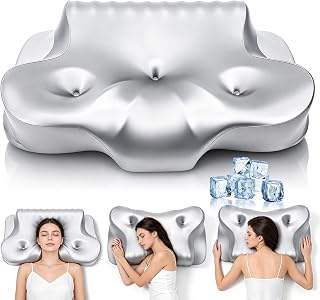
Upgrade pick: Dayme Memory Foam Pillows for Neck Support, Cooling Neck Pillow, Gray
 Visit on Amazon →
This is the contoured, neck-support side of the category: memory foam, a cooling cover, and a shape built to hold the curve under your head and neck rather than flattening into a pancake. If you sleep on your back, use a CPAP, or wake up with a stiff neck that you cannot trace to anything else, this is the style of pillow to look at, because the contour does the job a stack of flat pillows cannot.
Memory foam is also the fill with the most caveats, and I want you to know them before you order. First, off-gassing. Vacuum-sealed foam has a chemical odor when you open it. Give it two full days to plump and air out before you judge it. If a smell is still there after a week, send it back, because that is not a pillow you want near your face for the next five years.
Second, the cooling claim. A cooling cover is not the same as a fill that sleeps cool. Foam holds heat, which is why I do the 2 a.m. check instead of trusting the fabric name. If you run hot, use this one with a breathable cotton pillowcase and a cool bedroom, and see how you sleep in week two, not night one.
Third, foam flattens. Every foam pillow I have owned eventually loses loft, and that is the cost of the initial sink. Check it at month three and month twelve by pressing a flat palm into the center and seeing how much it springs back.
Flaws but not dealbreakers: the contour is not for stomach sleepers. A shaped pillow rotates a stomach sleeper's head to the side and puts the neck in a position it should not be in. Keep a flat, low pillow for that bed.
Anyone who sleeps on their back or side, wants neck support, and is willing to give foam two days to settle should look here first.
The actual how-to: matching a pillow to your sleep position
This is the part that matters more than any product. Work through it in order.
Step one: identify the position you actually wake up in. Not the position you fall asleep in. Check with a partner or a phone camera if you have to. Most people are surprised. Tom swears he sleeps on his side and he does, all night. I fall asleep on my back and stay there. The guest bed gets stomach sleepers, which is a third answer.
Step two: test the shoulder gap on your side. Lie on your side on the mattress you actually own, not a showroom bed. If your neck bends down toward the mattress, the pillow is too low. If your chin pushes up and your neck kinks, it is too high. A pillow that fills the gap between your ear and the mattress so your head stays level with your spine is the correct loft for you.
Step three: test your back position. Lie on your back and check that your chin is not tipping down toward your chest. That tip is what produces the morning neck ache people blame on the mattress. If it happens, your pillow is too tall for back sleeping, and no amount of fluffing fixes it.
Step four: test the stomach position, which is the one people get wrong. Stomach sleeping needs the lowest loft of the three, sometimes almost none. A tall pillow forces your head to one side and holds it there for eight hours. If someone in your house sleeps on their stomach, they need a thin flat pillow, full stop.
Step five: let it plump before you judge it. Vacuum-sealed pillows arrive flat as a pancake, and everyone panics. I have zero patience and slept on the flat version the first night anyway, and I regret it every time. Give it 24 to 48 hours to breathe, then press it and see what you actually bought.
Step six: recheck at month three and month twelve. This is where cheap fill shows itself. Press the center of the pillow and feel for a hollow. If your head is sinking to the mattress by month three, the pillow is not a five-year purchase, and you should plan accordingly rather than buying the same one again.
Step seven: wash it properly. Follow the tag. Dry it completely, because a damp fill is how pillows grow mildew and lose their loft permanently. Machine washable is a real advantage in a guest room, where the pillow may sit for months between uses.
Step eight: rotate and refresh. Two pillows per sleeper is the practical setup. Rotate them, and when one goes flat, the other is already broken in.
Where the other fills fall short
Down alternative is the fill I recommend to most people who want soft. The good ones have a soft casing, no chemical odor, and stitching that survives a wash, and a well-made set can absolutely be the best reasonably priced option in the house. The bad ones go flat in a season. That is the whole difference, and it is invisible in a listing photo.
Buckwheat is another level of support altogether. The heft tells you it is actually full, the fill does not migrate, and it holds the shape you push it into. It is also loud. The first night sounds like a bag of cereal, and the hulls compress over about five years. I love mine and I still keep a down alternative in the guest room, because the crunching is not for everyone.
Pure down is the gold standard I measure everything against. Heavy, plush, cloud-like, and priced like it. It is also why I amortize.
And the five dollar pillows are the reason people think they hate pillows. They are flat by week two. If you are shopping at that end, buy fewer pillows and buy the four-pack instead, because a set that survives a year beats four that do not.
What this all costs
Forget the sticker for a second and divide. Take the price of the pillow, divide it by the number of years you expect it to last, and compare that number across the options. That is the only comparison that has ever made sense to me, and it is why a contoured foam pillow can be the cheaper decision over five years than replacing a thin pillow every spring.
The rest of the budget is free. Two pillows per sleeper instead of one, a wash every few months, a breathable pillowcase, and a bedroom that is actually cool at night. The testing costs nothing but two weeks of logging.
Do that once, per bed, per sleeper, and you stop buying pillows you return. Tom has been on the same setup for years now. The guest room is next.