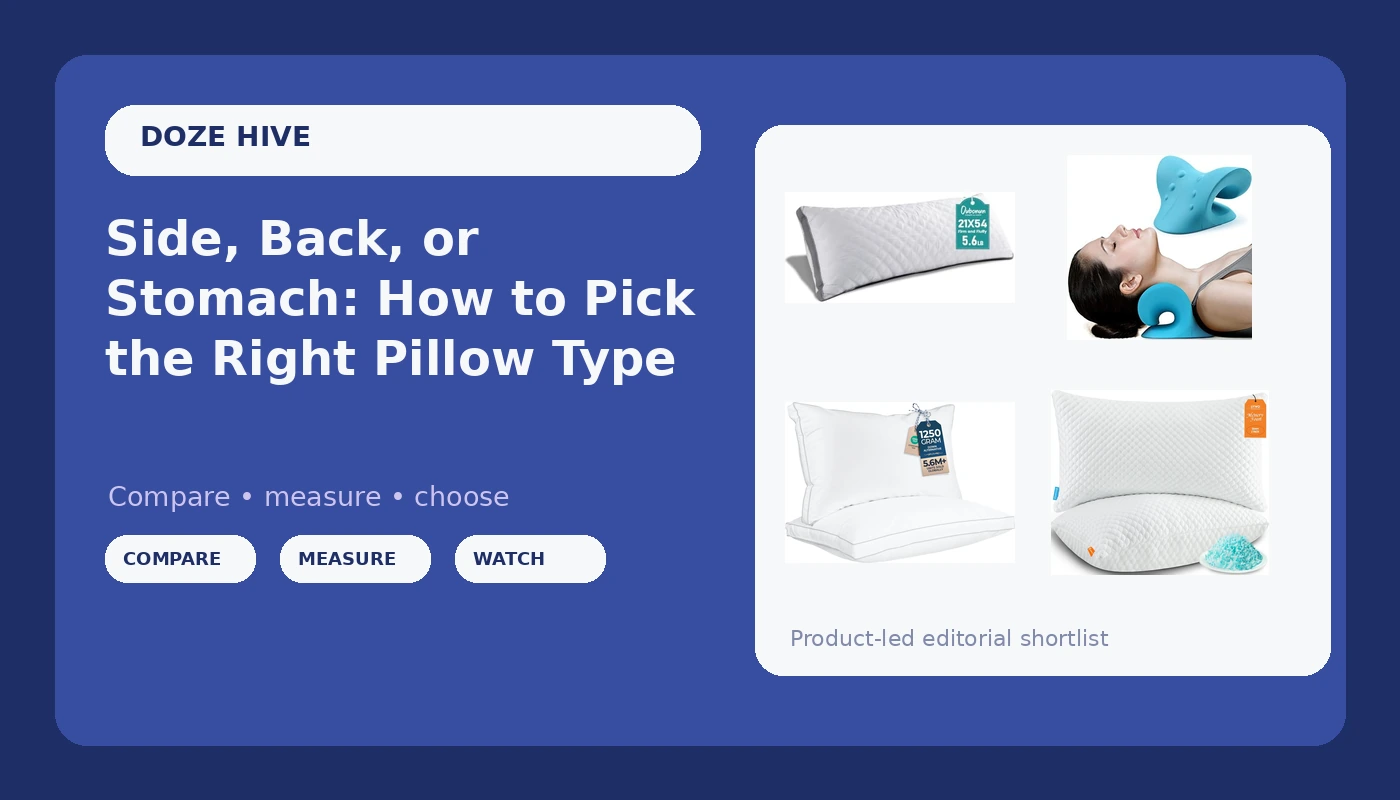
Sleep position decides which pillow works, and almost nothing else about a pillow matters as much. A side sleeper needs a tall pillow that fills the space between the ear and the outer edge of the shoulder. A back sleeper needs moderate loft that supports the curve of the neck without tipping the chin toward the chest. A stomach sleeper needs a thin, soft pillow, or none at all. That is why shopping for pillows for side and back sleepers is really two purchases wearing one label, and why a pillow with glowing reviews can still leave you rearranging it at 2 a.m. This guide covers four very different products, an adjustable memory foam set, a long body pillow, a cervical support device, and a gusseted king set, and explains which job each one is actually built to do.
Related: Memory Foam vs Down Alternative: Which Pillow Fill Holds Its Loft →
Quick answer
Match loft to sleep position before you compare fill, fabric, or price. Side sleepers want the tallest loft in the house, back sleepers want medium loft with neck support, and stomach sleepers want the least. Adjustable designs, including shredded foam sets and long body pillows, let you change loft after the pillow arrives instead of guessing from a product photo. Gusseted construction keeps a pillow's edge from tapering away to nothing, which matters most in a king set. A cervical traction device is a separate category: it supports the neck for short sessions rather than all-night sleep, and it does not replace a bed pillow. No single option here suits every sleeper, and none of them is a medical treatment.
Four options worth comparing
| Model | Best fit | What stands out |
|---|---|---|
| UYWO Cooling Pillows Queen Size Set of 2, Adjustable Memory Foam Pillows | Sleepers who want to tune loft after the pillow arrives | Adjustable memory foam fill, queen set of two, cooling cover |
| Oubonun Full Body Pillow for Side Sleeper, Adjustable Firm Long Bed Pillow | Side sleepers who need support along the whole body | Long full body length with an adjustable, firm build |
| RESTCLOUD Neck and Shoulder Relaxer, Cervical Traction Device (Blue) | Short sessions of neck and shoulder support | Shaped cervical traction device rather than a bed pillow |
| Utopia Bedding Gusset Bed Pillow, Hotel Pillows King Size Set of 2, White | King beds and guest rooms that need a defined edge | Gusset construction, king size, set of two, white finish |
Adjustable memory foam set: UYWO Cooling Pillows Queen Size Set of 2
The trade-off with any adjustable foam pillow is maintenance. Shredded fill shifts, so you will be pushing foam back toward the middle of the casing more often than you would with a solid pillow, and it needs a real fluffing routine. Memory foam also tends to arrive vacuum sealed, and it can carry an off-gassing smell out of the box, so give it time to plump and air before you judge the loft. Cooling covers are the most oversold phrase in bedding, and a cover alone does not stop foam from warming up overnight. If you sleep hot, treat the cooling claim as a question to test on your own, not a promise.
Full body pillow: Oubonun Full Body Pillow for Side Sleeper
A body pillow is a different tool from a head pillow, and it solves a problem head pillows cannot. When you sleep on your side, the top shoulder and the top knee can drift forward and rotate the spine, which is the same misalignment that shows up as morning stiffness. A long pillow gives those limbs somewhere to rest. The cost is space: this takes up real estate on a queen bed, and a partner may not appreciate the border. It is also a pillow you cannot really share, and if you rotate between your side and your back during the night, you will still want a separate head pillow sized for back sleeping.
Cervical support device: RESTCLOUD Neck and Shoulder Relaxer
This is the one item on the list that is not a bed pillow, and it should not be judged like one. A traction-style device holds the neck in a specific position for a limited stretch of time, usually on the floor or on a firm surface. It does not provide the loft a side sleeper needs, and using it as an overnight pillow defeats the purpose. Jaw and neck discomfort are also areas where the cause matters more than the product, so treat a device like this as something to discuss with a clinician rather than a self-diagnosis you settle with a purchase. Nothing here is medical advice, and a $30 device is not a substitute for an evaluation.
Hotel style king set: Utopia Bedding Gusset Bed Pillow
"Hotel quality" is a marketing phrase until the construction backs it up, which is why the gusset matters more than the word hotel. A gusseted pillow has a strip of fabric between the top and bottom panels, so the pillow keeps a boxy shape and holds its loft closer to the edge. That makes it a good fit for a king bed, where two wide pillows need to look full against a headboard, and for a guest room, where you are guessing at a visitor's preferred loft. The trade-off is that a gusseted king pillow is a big, firm object. A stomach sleeper or a small-framed back sleeper may find it too tall, and king pillows do not fit standard queen cases.
Prices and availability may change. Product images, names, and retailer links are matched to verified listings. No current price, rating, stock status, or measured result is stated here without current evidence.
How sleep position sets the loft you need
Loft is the height of a pillow when it is resting on the mattress, and it is the number that decides whether your neck stays neutral. Measure the gap between your ear and the outer edge of your shoulder while you lie on your side. That distance is roughly the loft a side sleeper needs, which for most adults is somewhere between four and six inches, and often more for broader shoulders. A pillow that is too low lets the head drop and bends the neck sideways. A pillow that is too high tips the head up and kinks the other direction. Both produce the same result: a sore neck and a lot of repositioning.
Back sleepers need less. The pillow should fill the curve at the base of the neck and support the head without pushing the chin toward the chest, so a medium loft that compresses to two or three inches under the weight of the head is usually the target. A pillow that is too tall for back sleeping pitches the head forward and can make snoring worse. Stomach sleepers need the least of all, often a thin pillow or none, because the head is already turned to the side and any extra height rotates the neck.
The complication is that many people do not stay in one position. If you fall asleep on your side and wake on your back, you are asking one pillow to serve two very different lofts. That is the case for an adjustable pillow, where you can dial in the fill for the position you spend the most hours in, and it is also the case for owning two pillows with different lofts rather than one compromise.
What "cooling" and "hotel quality" actually mean
A cooling pillow usually means one of three things: a cover fabric marketed for breathability, a gel layer, or shredded fill with more air between the pieces. Only the last two change how the pillow feels at 2 a.m., and none of them turn a warm pillow cold. The honest test is simple. Sleep on it, and if you wake up pushing the pillow to the cool side of the bed, the cooling claim did not hold for you. Warm sleepers should also look at fill type, because dense foam holds heat differently than a loose fill that lets air move through.
"Hotel quality" describes a look, not a specification. What you can actually check is construction and durability: a gusseted edge, stitching that stays closed after a wash, a casing that does not pill, and fill that returns to its shape after you press it flat. Those are the details that decide whether a pillow is still usable in year three. A pillow that arrives flat, stays flat, and smells like a chemical plant after a week of airing out has failed regardless of the phrase on the packaging.
- Identify the position you spend the most hours in, not the one you fall asleep in.
- Measure the ear to shoulder gap if you sleep on your side, and use that as your loft target.
- Check the fill type, then decide whether you want fixed loft or adjustable fill.
- Press the pillow flat with your palm and watch how quickly it returns, which tells you more than a firmness label.
- Divide the price by the number of years you expect to keep it before you decide it is too expensive.
Care, plumping, and returns before you commit
- Give a vacuum sealed pillow at least a full day, ideally two, to plump before you decide the loft is wrong.
- Air out any foam pillow somewhere ventilated if it carries an odor, and treat a smell that lingers past a week as a return.
- Fluff shredded fill back toward the center every few nights, since adjustable pillows migrate by design.
- Wash according to the care label, and check the stitching and casing seams after the first wash, not before.
- Keep the packaging and the return window open for at least two weeks of real nights in every position you sleep in.
Which option should you choose?
Choose the UYWO Cooling Pillows Queen Size Set of 2, Adjustable Memory Foam Pillows when you want to tune loft yourself and you share a queen bed, so both sides of the bed start from the same set. Choose the Oubonun Full Body Pillow for Side Sleeper, Adjustable Firm Long Bed Pillow when you sleep on your side and your shoulders or hips are the complaint, not just your neck. Choose the RESTCLOUD Neck and Shoulder Relaxer, Cervical Traction Device when you want short, targeted neck and shoulder support sessions and understand it is not a pillow you sleep on. Choose the Utopia Bedding Gusset Bed Pillow, Hotel Pillows King Size Set of 2, White when you are outfitting a king bed or a guest room and want a defined, hotel style edge that holds its shape.
One limitation worth naming: none of these descriptions tells you how a pillow will feel to you. Fill weight, loft after compression, and how hot a pillow sleeps are personal results, and the only reliable evidence is a few weeks of your own nights. The caveats above are also general guidance, not medical advice, and neck or jaw pain that persists deserves a clinician's attention rather than another pillow order.
The bottom line
Pillow shopping goes wrong when position gets skipped. Sort by loft first, then by fill, then by price, and the shortlist shrinks fast. An adjustable memory foam set covers sleepers who shift position and want to tune the loft themselves. A full body pillow handles the shoulder and hip alignment a head pillow cannot reach. A cervical support device is a separate short-session tool that should not be confused with a bed pillow. A gusseted king set is the practical answer for a king bed or a guest room that needs a crisp edge and a shape that survives a wash. Whichever you pick, plan on giving it two weeks and a proper plumping before you decide, and treat any cooling claim as something you verify at 2 a.m. rather than something you read on the package.