Most people buy a pillow the way they buy socks. Grab a set, tear the plastic, sleep on it flat that same night, then spend six months waking up with a stiff neck and blaming the mattress.
I'm Diane. I live in Austin, I'm retired from teaching middle school, and I have spent the better part of 15 years chasing a pillow I could actually keep. I have returned more Amazon orders than I can count. I sleep with a CPAP machine, blackout blinds, and an air filter running as white noise, and my adjustable bed has seen more pillow rotations than most mattress stores. My husband Tom is a lifelong side sleeper, I'm a back sleeper, and the guest bed gets stomach sleepers, so nothing earns a spot in this house until it has been slept on in all three positions.
CozyLux bed pillows are the simplest version of the question I get asked most: standard or queen, and how much loft is enough. Both sets are medium support, both come four to a set, and the real difference between them is two inches of width and the bed that width fits. That makes this a short guide. Measure, match the size, test the loft in your own bed, and then take care of what you bought so it lasts more than eighteen months.
Why you should trust me
I am not a sleep scientist. I am the person friends text at 10 p.m. asking whether the pillow they just ordered is the right one, and I have the receipts to answer.
Fifteen years of this has taught me a few things the hard way. I slept on a Tempurpedic foam pillow for over 20 years and loved the initial sink, but every foam replacement I ordered came back too hard, too soft, or too expensive, and I returned every single one. Tom and I spent $300 each on pure down pillows years ago and adored them, and retirement means watching the budget, so I started testing seriously instead of shopping by price tag. Since then I have run everything from down alternative to buckwheat through my own bed and the guest room, logging neck pain, tossing and turning, and the 2 a.m. overheating check every morning rather than trying to remember how the night went.
I test side, back, and stomach positions because my house contains all three. I check loft at month three and month twelve, because "going flat" is the thing nobody notices until their neck hurts. And I do not tell you what to do about your neck. I tell you what supported mine.
How I picked and how I tested
For a how-to article, the method matters more than the winner, so here is the whole thing.
Every pillow gets at least two weeks of real nights before it counts for anything. Side, back, and stomach, logged in the morning, not remembered at the end of the month. I score neck pain, I count how many times I woke up, and I note whether I woke up hot. A pillow that only works in one position gets written down as a one-position pillow, because that is what it is.
I also press on every pillow before I trust a firmness word. "Firm" has burned me before, and so has "hotel quality," which is a marketing phrase until the stitching, the casing, and the fill survive a real wash. I check fill weight by feel, I check whether the fill migrates to one corner overnight, and I check whether a vacuum-sealed pillow actually plumps back to its advertised loft or stays a pancake with opinions.
That is the standard I apply to everything, including the two sets below. Both are medium support, both are sold as sets of four, and both are the kind of purchase you make once and then stop thinking about, which is the whole point.
Size and loft, the two decisions that actually matter
Most pillow regret comes from skipping these two questions and going straight to the reviews.
What size pillow does your bed need?
The numbers in the product names are the footprint, not the height. Standard is 18" x 26" and queen is 18" x 28". The 18 is the same on both, so the only thing you are choosing is length: 26 inches or 28 inches.
Here is the direct answer. If you sleep on a twin or a full bed, or you are outfitting a guest room, buy standard. If you sleep on a queen or a king, or you are a side sleeper with broader shoulders, buy queen. The extra two inches sounds like nothing until your shoulder is pushing the pillow off center at 3 a.m. and you wake up with your head half on the mattress. That said, two inches of extra length on a twin bed is wasted width, and a wider pillow on a narrow bed just crowds the nightstand.
How much loft do you need for your sleep position?
Loft is height, and it is the measurement almost nobody lists. The short version: side sleepers need the most, back sleepers need the middle, stomach sleepers need the least.
Side sleeping leaves a gap between your ear and the mattress that your shoulder creates. If the pillow is too thin, your head drops and your neck bends down all night. If it is too thick, your neck cranes up. Back sleeping wants the head supported in roughly a neutral line, which is a medium loft for most adults. Stomach sleeping wants almost nothing, because anything tall twists the neck sideways.
Medium support is the middle setting. It is the safest single choice if your household has more than one kind of sleeper in it, and it is why a set of four medium pillows covers a guest room better than one expensive specialty pillow. If you are a strict side sleeper with a wide shoulder gap, expect to build height with a second pillow or a fold rather than finding one pillow that does it all.
What about fill and firmness claims?
Firmness words on a listing are close to useless on their own. Two pillows labeled medium can feel completely different, because fill type and fill weight do the actual work. Down alternative is soft and moldable, memory foam is dense and slow to recover, buckwheat is heavy and firm and sounds like a bag of cereal the first night. None of those is better. They are different tools.
My rule is simple: press on the pillow with your palm before you commit a whole bed to it, and check that the fill weight feels full rather than half empty. A pillow that feels like it is missing a third of its stuffing will be flat by month six, no matter what the label says.
The two CozyLux sets I would start with
These are the two options worth considering if you want one purchase that covers a whole bed or a whole guest room, rather than four mismatched pillows that each sleep differently.
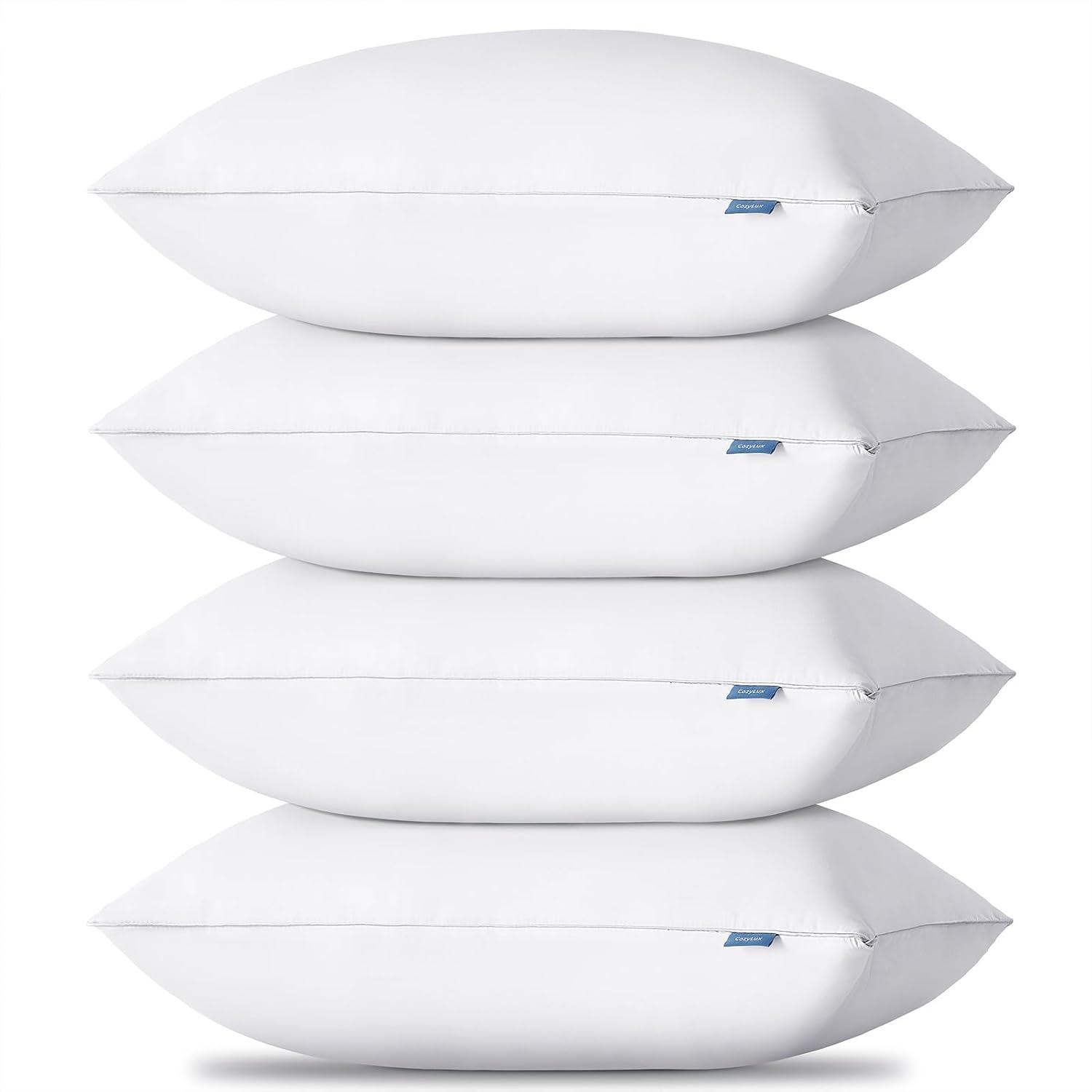
Standard-size pick: CozyLux Bed Pillows Standard Size Set of 4, 18" x 26", Medium Support
 Visit on Amazon →
The 18" x 26" footprint is the standard size, which means it fits standard pillowcases without a fight and sits correctly on a twin or full bed. Coming four to a set is the reason I point people here first for guest rooms. You get a matched set for two twin beds, or a full set for one bed with two spares to rotate, and rotating is how a pillow survives to year three instead of going flat in the first twelve months.
Medium support is the middle of the road, and for a guest room that is exactly right, because you do not know whether your visitor is a side sleeper or a stomach sleeper. Check current Amazon price before you decide, since sets like this move around.
Flaws but not dealbreakers: Medium support is not firm. If you are a dedicated side sleeper with a big shoulder gap, this alone may not fill it, and you will want to stack or fold. Also, a set of four arrives vacuum sealed, so give them two full days to plump before you judge them. I have zero patience and have slept on the flat version on night one more than once, and I do not recommend it.
Anyone outfitting a twin or full bed, or a guest room with two beds, should start here.
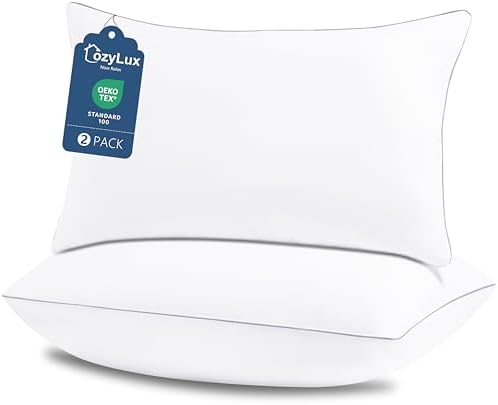
Our pick for queen beds: CozyLux Bed Pillows Queen Size Set of 4, 18" x 28", Medium Support
 Visit on Amazon →
Same medium support, same four-to-a-set packaging, two extra inches of length. On a queen or king bed that extra length is the difference between a pillow that stays where you put it and one that slides into the gap between the headboard and the mattress every night.
This is the one I would buy for a queen bed shared by two different kinds of sleepers. Four pillows means each person gets two, and two medium pillows can be arranged into more heights than one firm pillow can. Check current Amazon price and compare it against the standard set, because the difference between them is usually small relative to how much better the fit is on a wider bed.
Flaws but not dealbreakers: On a twin or full bed, that extra width crowds the corners and gets in the way. If your bed is narrow, buy the standard set and save the two inches. The other caveat is the same as above: medium is medium, and a side sleeper who needs serious height will still be stacking.
Anyone with a queen or king bed, or a side sleeper with broader shoulders, will get more out of this set.
The actual workflow, step by step
This works whether you buy one of the sets above or something else entirely.
Step one: Measure your bed and your shoulder. Mattress width decides the footprint. Your shoulder width decides whether you need the extra two inches. Twin and full point to standard, queen and king point to queen, and broad shoulders tip the decision toward the wider pillow even on a smaller bed.
Step two: Decide the size before you look at anything else. Size is the one thing you cannot adjust later. Fill can be added, folded, or removed. A pillow that is the wrong footprint stays the wrong footprint.
Step three: Press on the pillow before you commit a whole bed to it. Feel for fill weight and check that the casing does not feel thin enough to show the fill through it. If the pillow feels half empty in the store or in the box, it will feel worse in month six.
Step four: Give a vacuum-sealed pillow two full days. Take it out of the plastic, put it somewhere with air moving, and let it breathe. It will look skeptical on day one. That is normal. Judge it on day three, not on the night it arrived.
Step five: Run the two-week, three-position test. Sleep on it in your own position first, then try the other two for at least one night each. Log how you feel in the morning. A pillow that only works when you are on your back is a back pillow, and you should know that before the return window closes.
Step six: Do the 2 a.m. cooling check. If you wake up hot with a sweaty patch behind your neck, the cover is not cooling you, no matter what it says on the tag. Heat builds in the fill. This is the most lied-about claim in bedding, and the only test that matters is the one you run on yourself.
Step seven: Wash it the way you will actually wash it. Check the stitching and the casing after one wash. "Hotel quality" means nothing until a pillow survives a real cycle without the seams giving up or the fill bunching into one end.
Step eight: Rotate and re-fluff on a schedule. Flip and rotate every few weeks, and note the date you started. Check the loft at month three and month twelve. A pillow that has visibly flattened by month three will not make it to year five, and now you know while you can still do something about it.
What I skipped, and why
Memory foam is the fill I slept on for two decades, and I still miss that initial sink. It is also the fill most likely to arrive too hard, off-gas a chemical odor that lingers, and go flat in a way you cannot fix. If you buy foam, buy from a place with a real return policy and give it a week of airing out.
Buckwheat is another level of support entirely. The heft tells you it is actually full, and it holds its shape like nothing else. It is also loud the first week and it compresses over about five years, and it is not for a guest room, because the crunching is not for everyone. I keep it on my own bed and a softer fill in the guest room, and that is a deliberate split.
Down and down alternative are the soft, moldable end of the range. They envelope your head and part of your shoulder instead of fighting it, which is why so many people love them. They also need fluffing and they migrate to one corner if the casing is loose. A matched set of medium support pillows sits in the middle of all three of these, which is why it is the right first purchase for most beds.
What this all costs
Amortize it. That is the entire budget argument.
Whatever a set costs today, divide it by the years you get out of it. A set that lasts five years with rotation costs a fifth of its price per year. A cheap set that goes flat by month eight and gets replaced twice before that same five years is up costs more, and you spent those five years sleeping badly on top of it. That is the math that changed how I shop.
Two things make the math work in your favor. Four pillows instead of two means you can rotate, so each pillow gets half the wear. And a washable, well-stitched casing means the pillow can be cleaned instead of retired. Check current Amazon price on both sets, compare the difference between standard and queen, and then think about the five-year number instead of the checkout number.
The bottom line
Match the footprint to your bed, match the loft to your sleep position, give it two days to plump, and give it two weeks before you decide. Standard for twin, full, and guest rooms. Queen for queen and king beds and for broad-shouldered side sleepers. Medium support for households with more than one kind of sleeper in them.
Then log your nights, rotate your pillows, and stop buying replacements every year. A pillow is a five-year purchase. Treat the decision like one.